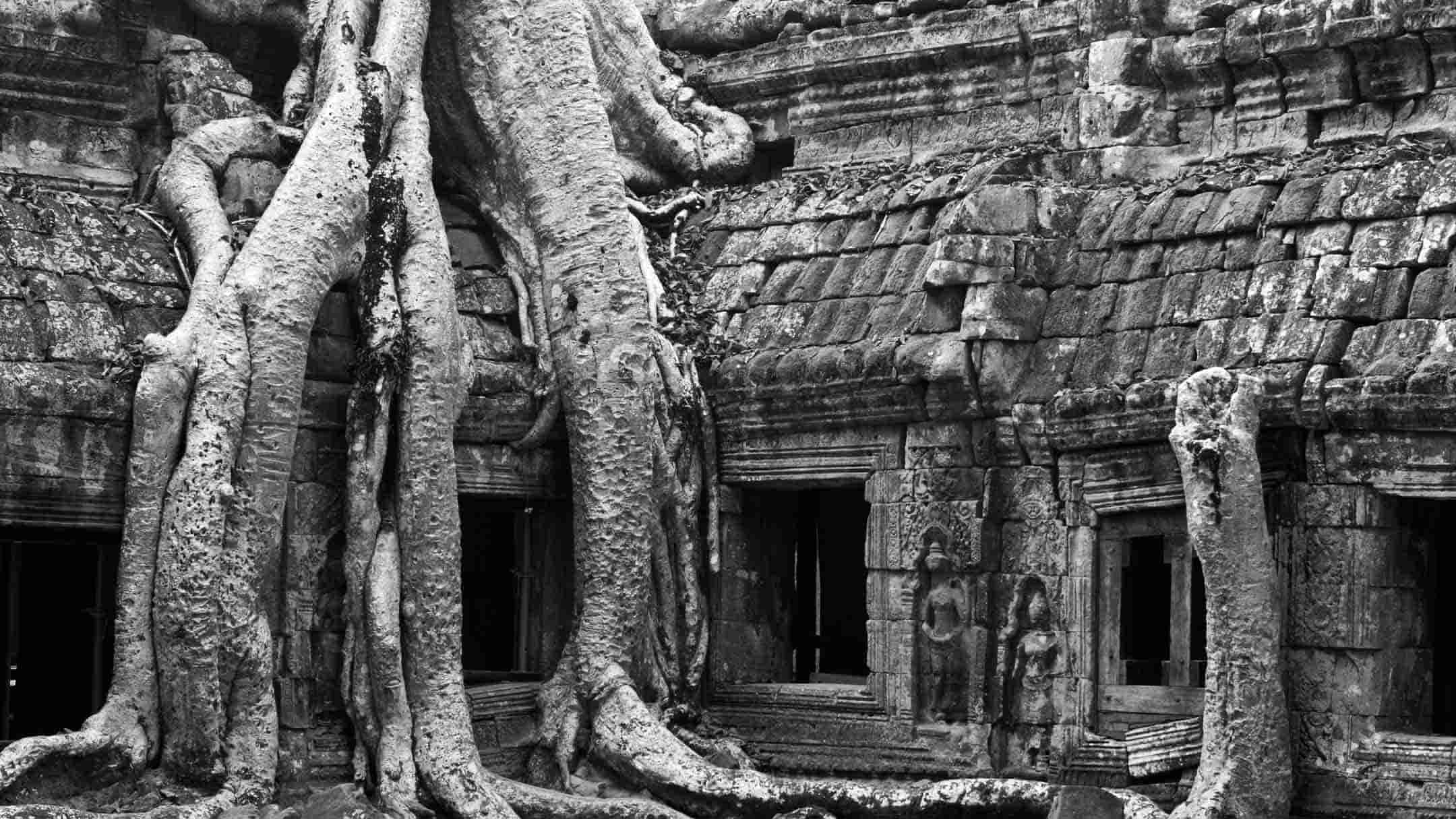
There is a reason the “Tomb Raider” temple is so popular with tourists – photogenic tree roots, everywhere!
By Rick’s Café Noir – 31 October 2025
When tourists visit the Angkor Archaeological Park in the northwest of Cambodia, the most popular temples on their bucket lists are Angkor Wat, the Bayon, and Ta Prohm. The 2001 Hollywood movie Tomb Raider, starring Angelina Jolie, brought the Angkor temples to a worldwide audience when Jolie disappeared into the “Tomb Raider Tree” doorway at Ta Prohm temple, pictured below. The movie also highlighted Angkor Wat – the floating village scene was shot on a set built over one of the two ponds to the west of the temple, with Angkor Wat in the background.

©2025 Rick Piper Photography. View a hi-res version of this image at rpphotoz.com
On the internet you can find many images of tree roots growing over temple structures, sometimes labelled as “Angkor Wat”. This is incorrect, and the misconception may have arisen from thinking that Angkor Wat is a group of temples, rather than it being just one temple in the Angkor Archaeological Park, albeit a big one. Many of these internet images are of the temple of Ta Prohm, but also of other temples with tree roots growing over stonework, such as Preah Khan, Banteay Kdei, and Ta Som. There are no tree roots growing over Angkor Wat.
Click the links below to jump to:
- When to Visit Ta Prohm
- History of Ta Prohm Temple
- Tree Species
- Photographing the Tree Roots
- Last Thoughts
- Camera Gear
When to Visit Ta Prohm
The best time to visit Ta Prohm is early in the morning, when it opens at 7:30am. At this time, many tourists will be eating breakfast, and you will probably have an hour or so with few other people around. Make the most of this time, especially if you want tourist-free shots of the tree roots, because an hour or so after opening, busloads of tourists will start to arrive, and most of them want to pose in front of spectacular tree roots – none more so than the “Tomb Raider Tree”.
The popularity of this tree-draped doorway cannot be overstated – it is even referred to by everyone as the “Tomb Raider Tree” – and most visitors want to be photographed with this tree in the background. If you want to get a shot of this tree with no people you will need to be early, otherwise you will probably have to wait for your shot, because this is what the scene looks like for most of the day:

©2025 Rick Piper Photography. View a hi-res version of this image at rpphotoz.com
However, all is not lost. Tourists are often part of a tour group, so once the group has finished posing and moves on, there may be a brief tourist-free window to take the shot before someone else moves into the frame. So, set up the shot, wait – although you could be in for a long wait, even 30 or 40 minutes – and be prepared to press that shutter button, as sometimes the tourist-free window is only one or two seconds!
So, the best strategy is to arrive early in the morning, before the tour groups descend on the temple, and have the temple almost to yourself. The end of the day is also usually good, and lunchtime sees fewer tourists, but the lighting can be harsh with the midday sun so high. I either get there early, or accept having to wait for a shot.
History of Ta Prohm Temple
Ta Prohm is both a Mahayana Buddhist temple and a monastic complex built by Jayavarman VII, the last of the great Khmer temple builders, and was known back then as the Royal Monastery, or Rajavihara. It was consecrated in 1186, and dedicated to the memory of his mother. The larger temple of Preah Khan, also built by Jayavarman VII, was dedicated to the king’s father.
Although the Ta Prohm complex was mostly built during the reign of Jayavarman VII, other kings added to it later, notably the now collapsed four face towers in the laterite outer fifth enclosure wall, which were probably added in the early 13th century, and some additional buildings within the temple itself.
What is not fully appreciated on a visit to Ta Prohm is the size of the overall complex. Not only was it a temple and a monastery, with 93 cells for the monks along the inside of the fourth enclosure wall, but it was also a fully inhabited city with a vast urban area beyond the temple proper. This now-forested area covers 60 hectares (148 acres) within the fifth enclosure walls and supported a population of over 12,000. The temple itself, within the inner three enclosures, only has an area of one hectare (2.5 acres), with many buildings crammed inside.
Tree Species
The trees growing over the stones of Ta Prohm with big gnarly roots are Spung trees – Tetrameles nudiflora – sometimes confused with Kapok trees – Bombax ceiba, a tropical species of kapok, related to Ceiba pentandra, otherwise known as the Silk-cotton tree (because of the cotton-like fibres it produces).
Also growing over the stones, to dramatic effect, are Strangler Figs – a species of Ficus – epiphytic plants that start as seeds dropped by birds onto a tree or sanctuary. The plants send out small aerial roots that find their way to the ground and grow bigger around the tree, or building, finally strangling it, and killing it.
The classic example of this is the Tomb Raider Tree, where the strangler fig has almost completely covered the big spung tree roots either side of the doorway.
All trees growing over stonework, although very photogenic, are bad news for temple structures. The roots, when small, penetrate the joints in the stonework and then expand as they grow, pushing the stones apart and weakening the structure. Eventually, the trees grow so big that their weight topples the weakened structure, or a storm has the same effect.
If you see trees that have been cut off above the stonework, it is to preempt the inevitable toppling of the tree and building. This only affects shots of the temples in which you want to include sky and trees. Mostly, though, people are shooting tighter, as with the Tomb Raider Tree and other impressive tree roots at Ta Prohm.
Photographing the Tree Roots
Much has changed at the Ta Prohm temple over the last 20 years. When I first visited the temple in 2005, you were free to wander wherever you wanted. All you could see was the temple ruins, fallen stone blocks, and tree roots. Some areas of the temple were in a parlous state, and off-limits, with signs warning of the danger.
Now, with the huge increase in tourist numbers, there are timber boardwalks and steps everywhere to corral visitors – there are even timber-decked posing platforms at the popular tree roots!
East Gate
Probably the most photographed spung tree at Ta Prohm, along with the Tomb Raider Tree, is the one on the northwest side of the East Gate entry in the fourth enclosure. In 2005 it looked like this:

©2025 Rick Piper Photography. View a hi-res version of this image at rpphotoz.com

©2025 Rick Piper Photography. View a hi-res version of this image at rpphotoz.com
Then, as now, it was very popular with tourists, who posed for photos among the tree roots and fallen stones.

©2025 Rick Piper Photography. View a hi-res version of this image at rpphotoz.com
Now, though, things have been cleaned up a bit. There is now a raised timber platform in front of the tree roots, complete with rope balustrade, for tourists to pose on. So, taking a shot that includes the entry gopura building and tree roots now includes the posing platform, unless you shoot above the platform.

©2025 Rick Piper Photography. View a hi-res version of this image at rpphotoz.com
Even to get a shot like the one above may take a bit of time. In the early morning there will be very few people around, so a clean shot is possible, but the roots will be in the shade. When light hits the roots, so do the tourists, so you may need to set up and wait to take the shot. Or, you could just go with the flow and include the tourists in the shot.

©2025 Rick Piper Photography. View a hi-res version of this image at rpphotoz.com
One-way Flow
Everywhere outside the temple’s third enclosure is two-way traffic, so you are free to roam, but once you pass the Hall of Dancers on its northern side and enter the third enclosure via the gate, you are subject to the APSARA National Authority (ANA) one-way flow. You can only enter the inner part of the temple at this point, and you cannot backtrack once inside the third enclosure, you have to go with the flow.
If you get dropped off by your driver at the western end of the temple complex, which is where most visitors are dropped off, not only are you entering the back of the temple, but you have to walk around the outside of the third enclosure to enter the temple proper on the eastern side. I always get dropped off at the eastern end of the complex.
The one-way flow is not as bad a it sounds, though – without the one-way system in such a small temple, with the huge number of tourists who visit now compared to 2005, it would be chaos.
Horizontal Roots
Once inside the third enclosure, you will see some big gnarly spung tree roots running horizontally across the ruins. Small roots of this tree grew between the stones, expanded over the years, and eventually caused the roof structure to collapse.

©2025 Rick Piper Photography. View a hi-res version of this image at rpphotoz.com
From there, the one-way flow takes you into the second enclosure. If you look carefully at the northeast corner on the outside of the first enclosure of the temple you will see the face of a devata peeping out between the tree roots that drape around a doorway, similar to the Tomb Raider Tree doorway. Serendipitous really, how the roots cover everything but the devata’s face.
The first image below shows the doorway, with the devata’s face down in the lower right of the picture. The second image is a closer view, with the face in the middle of the shot. Not always easy to spot, but if you look where the other tourists are looking and shooting, you will see it – it is well hidden!

©2025 Rick Piper Photography. View a hi-res version of this image at rpphotoz.com

©2025 Rick Piper Photography. View a hi-res version of this image at rpphotoz.com
Tomb Raider Tree
©2025 Rick Piper Photography. View a hi-res version of this image at rpphotoz.com

©2025 Rick Piper Photography. View a hi-res version of this image at rpphotoz.com
Once you enter the first enclosure on its north side, you will see the Tomb Raider Tree to your left. This location is very popular with tourists, so it is busy for most of the day, see images above and left. As previously mentioned, many tourists are part of tour groups, so if you want a tourist-free shot, set yourself up and wait for them to move on. You may only have a couple of seconds with no tourists in the frame, so be ready to shoot. Another option at the Tomb Raider Tree is to take close-up shots of the roots. By zooming in you can get some interesting compositions, as below.
Also, you do not have to worry about tourists getting in the way. The situation is actually the other way round – you are now in the way of their shots! But hey, everyone has to wait a bit – just spend some time watching a tour group pass through and you will see what I mean!


©2025 Rick Piper Photography. View a hi-res version of this image at rpphotoz.com
Second Enclosure Courtyard
When you exit the first enclosure at the southwest corner, after passing through the central sanctuary, you arrive in a small courtyard, bounded by the galleries of the second enclosure. In this southwestern courtyard is another spectacular spung tree, which has many roots covering the gallery, one of which runs along the roof of the gallery for several metres. It used to look like this, with many fallen stone blocks on the ground:

©2025 Rick Piper Photography. View a hi-res version of this image at rpphotoz.com

©2025 Rick Piper Photography. View a hi-res version of this image at rpphotoz.com
It was a very popular location to pose on the stones with the tree roots.

©2025 Rick Piper Photography. View a hi-res version of this image at rpphotoz.com

©2025 Rick Piper Photography. View a hi-res version of this image at rpphotoz.com

©2025 Rick Piper Photography. View a hi-res version of this image at rpphotoz.com
It is still very popular – the roots are still the same, but you cannot shoot scenes like those above now. Something has definitely been lost.

©2025 Rick Piper Photography. View a hi-res version of this image at rpphotoz.com
Compare the images above with these current views of the tree roots, left and below.
The dirt courtyard with many fallen stone blocks has now been completely covered with a raised timber deck, and an even higher posing platform, complete with timber balustrade in front of the tree roots.
You can still pose with the tree roots, and balustrade (!), so if this is your thing, then go for it, as people obviously do, see image left! To get a tourist-free shot here is difficult, but not impossible, although the final image is very different with the intrusive platform.

©2025 Rick Piper Photography. View a hi-res version of this image at rpphotoz.com
This spung tree is spectacular, but it has lost some of its appeal due to the intrusive timber decking, posing platform, and balustrade.
You can, of course, shoot above the platform, but you lose some of the scale, and the roots. It is useful to include the ground and gallery columns to provide a sense of scale, but the ground no longer exists! The fallen stone blocks added to the romantic vision of the ruins, but they are now covered by timber decking and a raised platform.
The decking and platform have probably been installed for safety reasons, to cope with so many visitors now, and to stop people damaging the roots, or themselves! This is one of the results of over-tourism. It is what it is, but you do have to wonder how some of these decisions were made – obviously not by photographers!
However, unknown to many tourists, because it is off the one-way flow route, there is, nearby, another similar small courtyard on this western gallery wall, to the northwest. As you are looking at the tree root on the gallery roof, turn to your right and then clamber through the gallery itself into another courtyard. The way through is in the left of the image below, behind the tourists – the spung tree is just visible on the left-hand side of the opening.

©2025 Rick Piper Photography. View a hi-res version of this image at rpphotoz.com
This courtyard looks like the southwest courtyard used to look – dirt ground, fallen stone blocks, no timber deck or posing platform, and another impressive spung tree.

©2025 Rick Piper Photography. View a hi-res version of this image at rpphotoz.com
Not only does this location feel more authentic, and provide a more romantic vision of the ruins, but it sees very few tourists, as most of them are in groups following a guide with a flag on the one-way route.
Outside the Third Enclosure
Most visitors are usually dropped off at the western end of the temple complex, which is actually the back of the temple, and then walk around the outside of the third enclosure wall to the eastern entry point of the temple proper – it is the only entry to the inner enclosures of the temple.
Outside of the third enclosure you are free to roam and explore wherever you wish, and here you will find spung trees growing over the laterite walls that separate the third enclosure of the temple from the monks’ cells built inside the fourth enclosure wall.

©2025 Rick Piper Photography. View a hi-res version of this image at rpphotoz.com
If you are interested in capturing studies of form and texture, you can get shots like the ones below. Even though there is a limited colour palette at the temples there are interesting textures – rough stone, smooth bark, and dried leaves.

©2025 Rick Piper Photography. View a hi-res version of this image at rpphotoz.com

©2025 Rick Piper Photography. View a hi-res version of this image at rpphotoz.com

©2025 Rick Piper Photography. View a hi-res version of this image at rpphotoz.com
Last Thoughts
If you want to capture some dramatic images of the spung tree roots and strangler figs growing over the temple ruins I hope the advice above will be helpful.
It will not be easy getting tourist-free shots – it is a very popular temple to visit – and there are now numerous timber boardwalks, steps, decking, and posing platforms that are difficult, and in some cases impossible, to keep out of the shot, but some patience can pay off, so best not to be rushing around.
Many guidebooks refer to the location of features by compass direction, so I usually carry a compass, or use a phone compass app. A headtorch is useful for viewing inside small, dark sanctuaries, as is a small LED light panel – not technically a strobe, but probably best not to flash it around and be mistaken for a pro. Although you could use the torch app on a phone, it means you have one hand less to use if you are taking photos.
Visit as early as possible, before the crowds arrive, or visit mid- to late afternoon when they have gone. I have been there when there was no one else in sight.
Of course, there is more to Ta Prohm than just tree roots, so I will be writing another post on everything else to see at Ta Prohm, later.
If you have never visited the temples at Angkor, you may find the following three posts useful as an introduction:

Historical overview and clarification
Practical advice

General advice for photographers, and resources
Camera Gear
All images in this post were shot with a variety of cameras, either:
- Using Fuji Sensia transparency film in Olympus OM1 cameras, with Zuiko lenses – transparencies were then scanned using a Nikon ED5000 film scanner and processed in Photoshop
- Or, shot in RAW using digital Nikon camera bodies, with Nikkor Pro f2.8 lenses, and then processed in Lightroom and Photoshop.
- Or, shot in RAW using digital Olympus OMD camera bodies, with Zuiko PRO f2.8 lenses, and then processed in Lightroom and Photoshop.
All images Copyright ©2025 Rick Piper Photography (unless noted otherwise). All rights reserved.


Leave a Reply