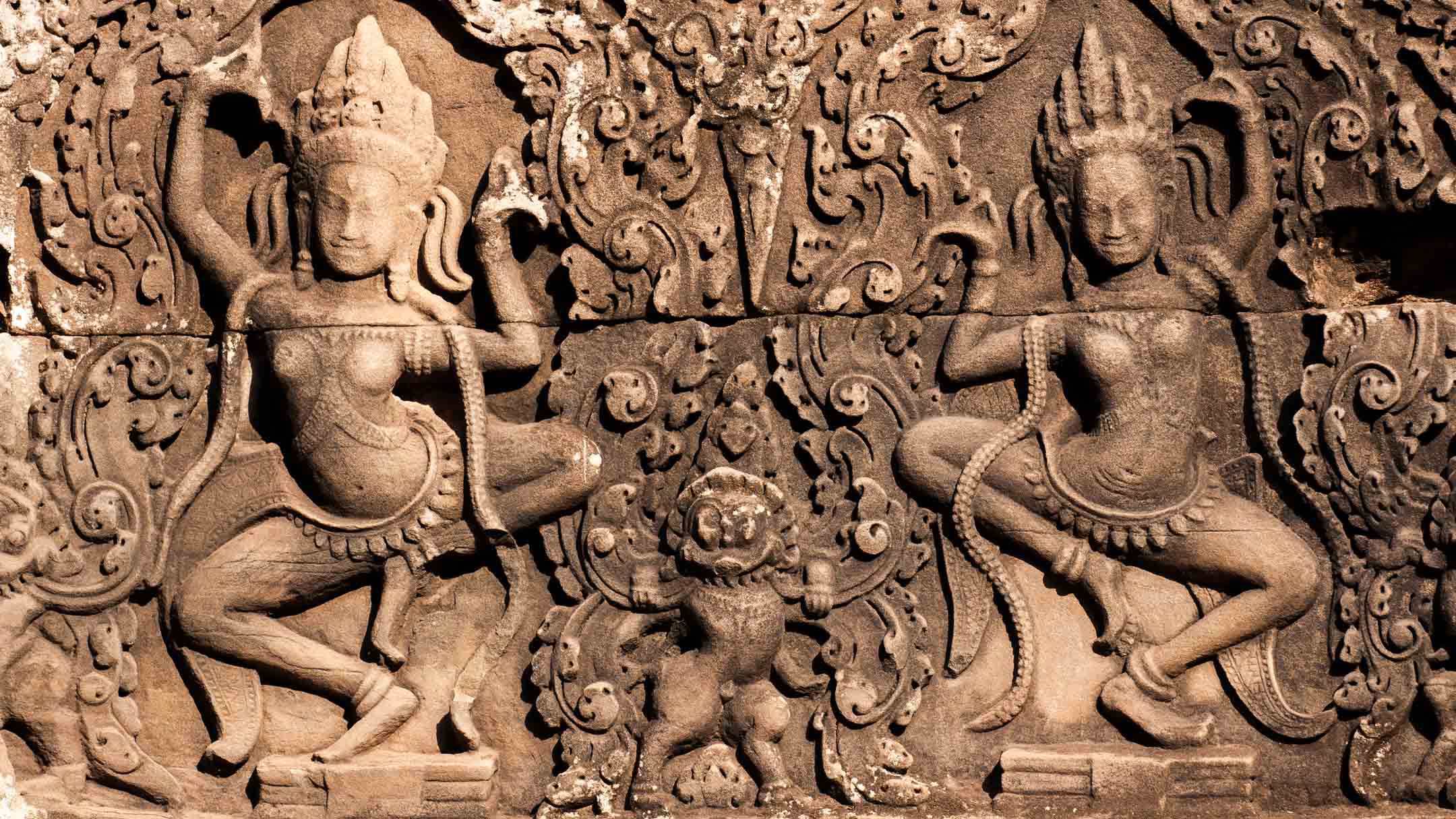
An introduction to the temples in the Angkor Archaeological Park, near Siem Reap, Cambodia, for the first-time visitor – photographic advice and resources
By Rick’s Café Noir – 10 October 2025
Many tourists going to Cambodia will visit the temples at Angkor. What they are actually exploring is the Angkor Archaeological Park, designated as a UNESCO World Heritage Site in 1992 – a must-see site for travel photographers and history buffs, and not to be missed.
This guide is written in three parts.
Part 1 is an introduction to the Angkor temples – a historical overview and some clarification.
Part 2 contains practical advice for visiting the temples.
This Part 3 has some general advice on photography, and some useful resources – click on the links below in Part 3 to read the contents listed.
Part 1 – historical overview and clarification:
- The Angkor Archaeological Park
- Temple Timeline
- What is Angkor Wat?
- The Face Towers of Angkor
- Tree Roots Growing Over Stone
- Apsaras or Devatas?
- Other Posts on the Angkor Temples
Part 2 – practical advice for visiting the temples:
- Visiting the Temples
- Ticket Pricing
- Other Posts on the Angkor Temples
Part 3 – use the links below to jump to:
- Advice for Photographers
- The Best Temple Guidebook
- Resources
- Last Thoughts
- Other Posts on the Angkor Temples
- Camera Gear
Advice for Photographers
This is some general advice concerning photography at the Angkor temples – what you are allowed to do, or not. I will give more specific advice in future posts on individual temples.
Commercial photography and videography
If you want to shoot a movie or commercial anywhere in or around the temples of the Angkor Archaeological Park you need to get permission, and pay a fee. The same applies for video and photo shoots for YouTube, music videos, entertainment programs, documentaries, commercials, guidebooks, catalogues, and magazines intended for local or international distribution.
Non-commercial photography media coverage
Official news organizations, both domestic and international, must apply for permission, but are exempt from fees when conducting coverage for informational purposes.
Personal and social media photography and videography
Special permissions or fees do not apply to personal photography. This includes pre-wedding and cultural-dress photo shoots for personal use, although a commercial wedding shoot would require permission.

©2025 Rick Piper Photography. View a hi-res version of this image, and more, at rpphotoz.com
I’ve seen a few tourists doing personal “fashion shoots”, having brought along a bag of clothes to change into. Obviously, a commercial fashion shoot would require permission.
Note that flash photography is banned everywhere at the Angkor temples.
Tripods
There are no restrictions on using tripods at the Angkor temples for personal photography. In 2022 there was some confusion, with claims that the Apsara National Authority (ANA) had announced a ban on the use of tripods without paying for permission to do so. This was later clarified by the ANA, which was merely trying to point out that commercial photo shoots (often using tripods, but also lights, reflectors, etc.) need to pay.
If you do use a tripod, be sure not to block the main paths or become a safety hazard for other visitors, or look like a pro on a commercial shoot!
Drones and GoPro cameras
The use of drones is banned at Angkor, unless you have permission and pay a fee. Also not permitted are the use of GoPro cameras, Insta 360 cameras, or 360-degree and 180-degree view cameras.
There are prominent signs at the temples depicting these restrictions, and if you do not have permission you risk permanent drone/camera confiscation, fines, and possible detention while your case is being sorted out. Needless to say, you will not be very popular with the authorities.
Having said that, and although it is illegal to fly a drone at the Angkor temples, or even for a few miles around the temples, there is a lot of Angkor drone footage on the internet, so if you have recent experience of flying a drone over the Angkor temples, please leave a comment below (anonymously if you wish!) and I will update this post accordingly.
Forbidden Photography Zones
Besides a general ban on flash photography everywhere at the temples, there are some restrictions on what you are allowed to photograph.
You cannot take photos inside the sanctuaries on the 3rd level of Angkor Wat, at archaeological dig sites, in active restoration work sites, at guard stations, or at any official buildings.
The Best Temple Guidebook
To get the most out of a visit to the Angkor Archaeological Park you will need a guidebook. If you only buy one guidebook to the Angkor temples, and there are many to choose from, I would recommend:
Focusing on the Angkor Temples – The Guidebook, by Michel Petrotchenko
I have bought many other guidebooks to the temples over the years, but none of them are as good to carry around as this one. It’s full of maps, plans, and photos, and is very detailed. It’s printed on glossy paper with a flexibound cover. This is, without a doubt, the ultimate Angkor temple guidebook to carry with you.
I cannot recommend this guidebook highly enough, just buy it! You will not regret it.
It was first published in 2011, then republished again in 2012 and 2014, and the fourth edition in 2017, which is the one I have. The last copy I bought cost US$25, from the Siem Reap Book Center, next to the U-Care Pharmacy opposite Pub Street, in 2020 just before the COVID pandemic lock-downs. If you see it for sale in Siem Reap and Phnom Penh bookshops, or at the temples, please let me know where and how much in the comments below, and I’ll update this post.
Unfortunately, it looks like the fourth edition is no longer in print to buy new from Amazon. It may still be stocked in bookshops in Cambodia, and is sometimes available second-hand – check Amazon, AbeBooks, and eBay. Any edition of this guidebook would be good to have.
Another option is to buy some of the five Kindle extracts from the print edition, in the Focussing on Angkor: The Guidebooks e-book series:
- Khmer History in Angkor Times (2015)
- Khmer Religion in Angkor Times (2015)
- Angkor Temples and Architecture (2015)
- Angkor Wat (2015)
- The Bayon (2016)
These are currently available to download from Amazon USA, Amazon UK, and Amazon Australia
Resources
Here are some useful resources for researching the Angkor temples. Many of these books are available to purchase in Siem Reap and Phnom Penh bookshops, and the popular titles are often sold by hawkers at the Angkor temples.
Alternatively, buy online before your visit, especially if you have limited time at the temples and want to be sufficiently informed before your trip. I bought copies of all the books listed below in Siem Reap, mostly from the Siem Reap Book Center, next to the U-Care Pharmacy opposite Pub Street.
- Cultural Travel Guides: The Treasures of Angkor
- Albanese, M. (2006). White Star Publishers. This book, by Italian freelance journalist and Sanskrit/Indology scholar Marilia Albanese, has a good introduction to Khmer culture, religion, and architectural styles. Each temple has detailed floor plans and very good photos. Worth reading to plan what to see before visiting the temples.
- The Angkor Guidebook: Your Essential Companion to the Temples
- Booth, A. (2016). ABOUT Asia Travel. This small hardback book, complete with slip case, is more of a coffee table book than a guidebook to carry around at the temples. Containing excellent information, photos, and historical illustrations and photos, this book also has 21 full colour virtual temple restorations, by Bruno Lévy. Printed on clear overlays to photos of the temples as they are today, they show what these ruined temples would have looked like in their heyday. A beautiful book to own for research before your trip, or a great souvenir to remember the temples by.
- A History of Cambodia
- Chandler, D. (2008). Westview Press. This book, by Australian history professor David Chandler, covers the history of Cambodia from pre-Angkor times to the end of the twentieth century. Essential background information to the history of the Angkor period, but also to the general history of Cambodia – useful for understanding the tragic history of recent times.
- Angkor: Heart of an Asian Empire
- Dagens, B. (1995). (R. Sharman, Trans). Thames & Hudson. (Original work published 1989). This book, by French art historian Bruno Dagens, covers the story of the European rediscovery and restoration of the temples at Angkor, and contains many excellent historical photos, paintings, and line illustrations from the 19th and early 20th centuries, showing the parlous state of many of the temples at that time. Probably the best book to read if you have an interest in the state of the temples when they were rediscovered, and the amount of restoration work accomplished since.
- Ancient Angkor
- Freeman, M., & Jacques, C. (2006). Thames & Hudson Ltd. Originally published in 1999, and then revised and republished in 2003, this is an excellent guide written by French scholar Claude Jacques, with detailed floor plans, and photos by Michael Freeman. An interesting aspect of this book are the photos – many taken in the 80s and 90s. Freeman was the first photographer allowed prolonged access to the temples after two decades of war, genocide, and civil war. Consequently, the temples are shown with vegetation spouting out of the stonework as a result of neglect due to war, but since cleaned up, which is what we see today. It would have been great to see the temples as Freeman saw them.
- Angkor Wat: The Ancient Chronicles of Cambodia’s Stone Giant
- Get.factual (2023). History documentary [YouTube]. A 55-minute documentary examining the why? and how? of Angkor Wat’s construction. Shows how the use of satellite imagery and LiDAR mapping are furthering this understanding. Mention is made of the importance of the surrounding moat, which for centuries has kept the subsoil under the temple moist, and thereby prevented collapse. Well worth watching.
- National Geographic: Angkor Wat – Access 360 World Heritage
- National Geographic (2013). History documentary [YouTube]. An interesting 22-minute documentary about new discoveries at Angkor using LiDAR mapping technology for aerial archaeology. Using this technology, structures hidden by the jungle for centuries become visible and can be located on the ground.
- National Geographic: Engineering the Impossible – Angkor Wat
- National Geographic (2007). History documentary [DVD]. This 50-minute documentary examines the period of Khmer history when Angkor Wat was built. It covers the construction methods and engineering of the temple, and the vast infrastructure of waterways, farmland, and people required to achieve it. Archaeologists in the documentary posit that Angkor Wat, being permanently surrounded by a moat for centuries, is actually “floating” on saturated subsoil and therefore was not subjected to the expansion and contraction of the subsoil caused by the annual wet and dry seasons, and so avoided the collapse experienced by many other temples.
- Angkor: Celestial Temples of the Khmer Empire
- Ortner, J. (2002). Abbeville Press. This is a book of Angkor temple photos by photographer Jon Ortner, with captions by several authors, and detailed sections on history, religion, culture, the Angkorean calendar, architecture, conservation, geography, and hydrology, also written by contributing authors. It includes Angkor temples in Thailand, too. This is a good book for researching Angkor and working out what to see, but not really a guidebook to carry around like Petrotchenko’s guide.
- The Mekong: Turbulent Past, Uncertain Future
- Osborne, M. (2001). Grove Press. The history of the Mekong River over the last 2000 years, including its importance in the rise of the Khmer empire of Angkor.
- Southeast Asia: An introductory History
- Osborne, M. (2021). (13th ed.). Allen & Unwin. A general history of southeast Asia, and good for understanding how ancient cultures in the region have influenced modern societies.
- Focussing on the Angkor Temples: The Guidebook
- Petrotchenko, M. (2017). (4th ed.). Michel Petrotchenko (Pub.) If you only want to buy one guidebook to the temples at Angkor, Petrotchenko’s book is probably the best. The floor plans are excellent and clearly marked with the features not to miss, and there are many photos. History, chronology of Angkorean kings, religion, architectural features – it’s all covered. I have found it to be the best guidebook to carry around at the temples.
- Angkor: Cambodia’s Wondrous Khmer Temples
- Rooney, D. (2011). (6th ed). Odyssey Guides. A very good guide to the Angkor temples, including extensive historical background, and coverage of restoration, culture, religion, and architecture, by art historian, Dawn Rooney. Good photos and information on individual temples, with basic floor plans – not as good as the floor plans in Petrotchenko’s guidebook – but, at just under 500 pages, and weighing 860gms (1.9 lbs) it is not really a book you would carry around all day. Excellent for research, though.
- Angkor: Why an Ancient Civilisation Collapsed
- Stone, R. (2009, July). National Geographic. The article is also known as Divining Angkor on the National Geographic website, if you are a subscriber. It discusses how the city of Angkor may have engineered its own downfall. If you can obtain a copy of the print magazine it also included a large supplemental map, Southeast Asia: Monsoon Latitudes, on the reverse of which is an excellent graphic of the Khmer empire with photos, illustrations and a historical timeline.
- Angkor Wat: The Ancient Mystery Of Cambodia’s Lost Capital – City of the God-Kings
- Timeline (2017). History documentary [YouTube]. A 50-minute documentary, with a somewhat misleading title, examining the history of the city of Angkor, the Angkor kingdom, and Khmer culture – not just Angkor Wat as the title suggests – and uses satellite imagery and LiDAR mapping to further understand how this great empire evolved. Includes some photos from the 19th century, and early film – what you see now is nothing like what was discovered in the 1860s!
- There are sections on the temples at Angkor in various travel guidebooks, such as Lonely Planet, Rough Guides, and DK Eyewitness Travel, although they are usually brief, have few photos, and lack detailed floor plans.
Last Thoughts
If you are a keen photographer visiting the Angkor temples, the last advice I would give is to plan ahead – read Petrotchenko’s guidebook, and carry it with you – try not to look like a pro, and most importantly, slow down.
Research into the temples will pay off when you find yourself in the right place at the right time, and if you want your visit to the Angkor temples to be rewarding, it’s probably a good idea to inform yourself about:
- The architecture and construction of the temples – what the various building features are, and their function. Then you will know what the guidebooks are talking about.
- A knowledge of Hindu and Buddhist mythology, which informs a lot of the building designs and the stories carved in stone (particularly the bas-reliefs), so you know what you are looking at.
- The geopolitics of ancient SE Asia, which led to frequent wars with the neighbouring Cham and Siamese kingdoms over several centuries. There is a reason for so many bas-relief scenes of battles and war elephants!
- The history of European rediscovery and temple restoration, because what you see now is nothing like what the first European explorers found. Even Ta Prohm, with its controlled “wild state”, cutback vegetation, and restored stonework, is nothing like the condition in which it was found. Probably the temple in the closest state to how it was discovered is Beng Mealea, a real “Indiana Jones” type environment of jungle and ruins, but even there, there are now elevated boardwalks over the ruins.
With increased knowledge, you will probably find yourself spending longer at the temples, and really appreciating the skills of the ancient builders and stonemasons.
Slowing down means you can afford to wait for the perfect shot, the “hero” shot. I’ve seen many tourists rushing around grabbing shots at as many temples as they can visit in a day – a visual record of their trip. Maybe they have limited time, or minimal interest in the history and mythology, and quick grab shots will suffice, but if you want to capture really good images, I would advise you to be informed about what you are photographing, and importantly, slow down.
There are hundreds of tourists at the popular temples, so you need to be prepared to wait if you are hoping for a tourist-free shot. It is a valid concern, because, for some of my images I have had to wait 30 or 40 minutes to get the shot, and in some cases the tourist-free window was only one or two seconds! Be ready to press that shutter button!


The Bayon and Ta Prohm temples get particularly busy, especially if you want a shot of the “Tomb Raider” tree – any tree roots, actually – or an enigmatic stone face. If you want to avoid being part of the crowds, like in the images above and below, try to arrive early, when many tourists will be eating breakfast in their hotels.

©2025 Rick Piper Photography. View a hi-res version of this image, and more, at rpphotoz.com
Sometimes, the wait for a tourist-free shot of the tree roots at Ta Prohm temple is so long that the tourists become the subject!

©2025 Rick Piper Photography. View a hi-res version of this image, and more, at rpphotoz.com
If you are not able to avoid the crowds, Lightroom may be a solution. The latest (June 2025) versions of Lightroom Classic (14.4), and Lightroom (8.4) now include “AI people removal”. I have not tried it, but it could significantly reduce your waiting times to get perfect shots. If you have used this LR feature please leave a comment – I would be very interested to know how successful it is, particularly with complex backgrounds or crowd scenes, like those above.
Other Posts on the Angkor Temples
This post, Part 3, contains general photographic advice and some useful resources for researching the temples.
Part 1 is a general introduction to Angkor, mainly a historical overview and some clarification.
Part 2 contains practical advice for visiting the temples.
Other posts in this series will address individual temples, with tips for getting the most out of your visit photographically. If there is a hyperlink in the list below, I have written the post.
These blog posts, based on my experiences, may help you get some great images. I hope you will be inspired!
- Angkor Thom – Ancient Khmer City
- The walled capital city of the Khmer Angkorean empire for over 200 years. Enjoy some seclusion by walking along the top of the the city walls, far from the madding crowd.
- Angkor Thom – Elephant Terrace
- Where the king used to dispense justice to his subjects, review military parades, and mount his elephant – luxury transport back in the day.
- Angkor Thom – Royal Palace Compound & Phimeanakas Temple
- Not a lot remains, other than the Phimeanakis Temple and the Royal Pond, as the Royal Palace was a timber building, but the steps down to the pond are worth a closer look.
- Angkor Thom – Suor Prat, the Khleangs, and Preah Pitu
- There is no consensus about the functions of these buildings – are they sanctuaries, storehouses, or function rooms? Generally deserted, as not many people have time to visit.
- Angkor Thom – Terrace of the Leper King
- The inner wall carvings are in excellent condition – being undiscovered until restoration work in the 1990s, due to being back-filled with dirt after a partial collapse of the original wall necessitated the construction of a new outer wall.
- Angkor Wat – Introduction
- Who built Angkor Wat? How long did it take? How was it built? The largest religious structure in the world with so much to see you could spend days there!
- Angkor Wat – Western Gate
- The usual entry point for a visit to the temple after crossing the moat – with 258 devatas carved into the walls of the western gate, there is a lot to explore.
- Angkor Wat – Eastern Gate
- Often ignored, but an alternative entry point to the temple – well-worth a visit for the interesting devata carvings and bas-reliefs, and lack of tourists.
- Angkor Wat – Cruciform Galleries
- Dancing apsaras and beautiful devatas decorate the walls of the four inner courtyards – timing is critical to get shadow-free images of the devatas.
- Angkor Wat – 2nd Level
- Over 200 devatas – including eccentric hairstyles, groups of ladies, toothy twins, and even an angry looking devata – and access to the 3rd Level.
- Angkor Wat – 3rd Level
- Is it worth the wait to get up to the 3rd level to see some fine examples of the Khmer stonemason’s art? Yes, definitely, and there is a way to avoid the tourist crowds and the long queue, too.
- Angkor Wat – Sunrise and Sunset
- Is it worth the effort, and the waiting, for what may be slightly disappointing, or even underwhelming?
- Banteay Kdei
- A smaller version of Ta Prohm and Preah Khan – and less crowded with tourists – this Buddhist monastic complex has a well preserved face tower on the Eastern Gate, and some lovely devata carvings.
- Banteay Samre
- Out of the way, rarely visited by tourists – you could have the place to yourself, almost!
- Banteay Srei
- Superbly detailed small temple, and the first in Cambodia to be restored using the anastylosis method of reconstruction. Get there early to avoid the crowds!
- Baphuon
- Restoration, interrupted! Did this result in the biggest three-dimensional puzzle in the world? A remarkable reconstruction!
- Bayon – Face Towers
- Enigmatic and gigantic, 173 stone faces adorn the remaining 37 towers on the upper-level cruciform platform. Why are they there, and whose face is it?
- Bayon – Bas-reliefs
- The religious, military and everyday life of the Khmer empire, carved in stone.
- Bayon – Devatas and Apsaras
- Are all the carvings of beautiful ladies Apsaras? Are Devatas and Apsaras the same thing, or is there a difference between them?
- Face Towers at the Angkor Temples
- Which temples have giant stone faces – not Angkor Wat! – and whose face is it anyway?
- Frame the Shot
- Using the technique of hard and soft framing to emphasise architectural features.
- Preah Khan – Eastern Entry
- Eastern entry and moat. This magnificent entrance was the main entry to Preah Khan, and if you go there first you will avoid the crowds for a couple of hours, as most visitors arrive at the Western entry.
- Preah Khan – Hall of Dancers
- Hall of Dancers and the east section and Library building – probably the best preserved Hall of Dancers at Angkor.
- Preah Khan – Central Courtyards
- Central section courtyards, chapels, and some beautifully carved devatas – sometimes hard to find!
- Preah Khan – Western Entry
- Western entry and temple. This is where most visitors enter Preah Khan, so it is usually crowded – but it is the back of the temple!
- Ta Prohm
- Although originally left in more-or-less the condition in which it was found to provide a romantic vision of the ruins, this temple has undergone extensive restoration. There is more to Ta Prohm than tree roots growing over stone – a four-faced tower, fine carvings, even a carved dinosaur (?) medallion!
- Ta Prohm – Tree Roots
- There is a reason the “Tomb Raider” temple is so popular with tourists – photogenic tree roots everywhere!
- Tree Roots at the Angkor Temples
- Which temples have tree roots growing over the stonework? Quite a few, but not Angkor Wat!
Camera Gear
All images in this post were shot either:
- Using Fuji Sensia transparency film in Olympus OM1 cameras, with Zuiko lenses – transparencies were then scanned using a Nikon ED5000 film scanner and processed in Photoshop
- Or, shot in RAW using digital Nikon camera bodies, with Nikkor Pro f2.8 lenses, and then processed in Lightroom and Photoshop.
- Or, shot in RAW using digital Olympus OMD camera bodies, with Zuiko PRO f2.8 lenses, and then processed in Lightroom and Photoshop.
All images Copyright ©2025 Rick Piper Photography (unless noted otherwise). All rights reserved.

Leave a Reply