Category: Architecture

Modern and historical

  • Angkor Temples – Part 2

    Angkor Temples – Part 2


    Part 3 – general advice for photographers, and resources:


    Map of the Angkor temples showing the Small Tour Circuit (purple line) and the Grand Tour Circuit (red line).
    Map of the Angkor temples showing the Small Tour Circuit (purple line) and the Grand Tour Circuit (red line).

    For that $20 you get a driver for the day. When they drop you off at a temple they will park their tuk-tuk in a parking area amongst a sea of other tuk-tuks, so make sure you can identify your tuk-tuk when you return. Drivers will sometimes sleep while you visit the temple, or play on their phones, or improve their language skills online if they really want to get more more customers. What they will not do is be your guide around the temple.

    Over the years I have had drivers with very poor English, or who objected to changes of itinerary, or were dangerous drivers – one of them veered off the sealed road at the temples and almost overturned the tuk-tuk on the sloping verge! He was actually the cousin of the driver I had arranged to pick me up the day before, who could not make it. So, if you get a good driver, use them for further trips.

    If another tourist recommends a good driver, it may be a good idea to use them. The drivers are relying on word-of-mouth recommendations to keep working. Hotels and guesthouses often have a group of tuk-tuk and car drivers they use – usually more expensive, but usually reliable. Sometimes they are extended-family members, so they will be accommodating, and not want to let down the owner of manager of the hotel or guesthouse.

    The riskiest, and cheapest, option is to pick a random driver off the street, of which there are many, which is what I usually do!

    Talk to them, assess their language skills, if that is important to you – you can always point to temples on an Angkor map, which will sometimes have Khmer script as well as English, or point to your watch or phone to arrange times. Over the years, and many trips to the temples, I have found older drivers to be more reliable, and safer, than younger drivers. Not always the case, I know, but something to consider.

    Map of the Angkor temples showing the Small Tour Circuit (purple line) and the Grand Tour Circuit (red line).
    Map of the Angkor temples showing the Small Tour Circuit (purple line) and the Grand Tour Circuit (red line).

    [Back to Top]

    The Small Tour Circuit takes in Angkor Wat, then heads a kilometre north to enter the city of Angkor Thom via the South Gate to visit the Bayon, and the Royal Terraces (Elephant and Leper King), and maybe the Baphuon, then exit via the eastern Victory Gate, maybe take in Thommanon, Chau Say Tevoda, and Ta Keo, definitely Ta Prohm, and maybe Banteay Kdei and Srah Srang.

    You can of course do this route in reverse order by visiting Srah Srang for the sunrise, and then heading across the road (literally) to Banteay Kdei, where you may be the only visitor and have the temple to yourself. Or, after Srah Srang, go to the nearby Ta Prohm temple, and again, be one of the first ones there – two hours later (after hotel breakfast) there will be coachloads of visitors!

    If are you limited to a one-day visit the Small Tour Circuit will enable you to see the major temples, and a few smaller ones, but it will be a rush. You will also not necessarily be at a particular temple at the best time of day for photography. You will be there at the same time as a lot of other tourists.

    You will probably be templed-out at the end of the day, especially if you started early to see the sunrise over Angkor Wat, and then stay for the sunset from Phnom Bakheng. From starting at your hotel in Siem Reap to finally getting back there in the evening is a long day – a 14-hour day! I have done it a few times – it was exhausting every time.

    [Back to Top]

    The Grand Tour Circuit is even more ambitious, and slightly more expensive, due to the extra distance involved. This route assumes you have already done the small circuit so avoids stopping at Angkor Wat, and passes through Angkor Thom via the South and North Gates, then on to the first stop at Preah Khan temple, maybe Krol Ko and Neak Pean, then Ta Som, East Mebon and Pre Rup, and maybe Ta Prohm, Banteay Kdei, and Srah Srang on the way back to Siem Reap.

    Another exhausting day, for sure! Not much time at each temple, and again, you will be there at the same time as a lot of other tourists. It’s even more exhausting if you take in the sunrise and sunset.

    My advice would be to spend more than one day visiting the temples and be selective about what you see – you don’t have to see everything in one day. Make your own circuit and choose temples and times to get the best photographic conditions, and fewer tourists. That takes a bit of research and planning, and my various posts may be able to help you there. Be sure to agree the route, timing, and price with your driver before you start, and expect any deviations from the agreed route to cost extra.

    [Back to Top]

    Angkor Wat temple silhouetted against a yellow cloudy sky at sunrise, Cambodia
    Angkor Wat temple at sunrise.
    ©2025 Rick Piper Photography. View a hi-res version of this image, and more, at rpphotoz.com

    [Back to Top]

    Cambodia has a tropical monsoon climate, so it’s hot all year round, and wet more than it is dry. The “cooler” dry season is from November to February, and is the most popular time for tourists to visit, so if you visit at that time, expect crowds.

    If you are not used to high temperatures be careful not to get heat stressed, which can lead to heat exhaustion and heat stroke. Take it easy, and stay hydrated.

    There’s not a lot of shade at the temples so you will be exposed to the sun a lot of the time. Wear clothes that cover you to avoid burning, sunscreen, and a hat – observe the locals who work outside around the temples, fully covered from head to toe, including gloves! Some visitors carry umbrellas.

    Covering up is required at the temples to a certain extent to be respectful – you are visiting religious buildings still in use, not the beach – and the temple guardians who check your tickets at the entry points won’t let you in if you are showing too much skin. This is variably enforced at different temples, but access to the 3rd level of Angkor Wat has strict dress standards – you even have to remove your hat before climbing the steps.

    Of course, wearing a hat with a big enough brim to protect your face is a problem for photographers – landscape aspect shots are fine, but portrait aspect shots are impossible. Some photographers wear a baseball cap on backwards, but this does not protect the face or ears.

    My solution is to wear a small-brimmed bucket-style hat – to protect the top of my head, ears and forehead – so I can easily shoot in landscape or portrait – and either a shemagh or a traditional Khmer krama scarf around my neck. Either type of scarf is very versatile, and can be wrapped around to cover the whole head/face if necessary – useful on the drive back to Siem Reap with all the exhaust fumes and dirt, especially if you do not have a mask. The scarf is also useful for mopping up sweat, like a towel, although I have seen photographers with hand-towels for that purpose.

    You also need to be reasonably fit. You will be climbing up and down steps everywhere. For example, to get from ground level to the central sanctuary on the third level of Angkor Wat you need to climb up a total of 150 steps, and then climb down again.

    [Back to Top]

    Accessibility

    Steep stone steps between Level 2 and Level 3 of Angkor Wat, Angkor Archaeological Park, Cambodia
    Steep stone steps between Level 2 and Level 3 of Angkor Wat, Angkor Archaeological Park, Cambodia.
    ©2025 Rick Piper Photography. View a hi-res version of this image, and more, at rpphotz.com
    Tourists on the steep wooden steps between Level 2 and Level 3 of Angkor Wat, Angkor Archaeological Park, Cambodia
    Tourists on the steep wooden steps between Level 2 and Level 3 of Angkor Wat, Angkor Archaeological Park, Cambodia.
    ©2025 Rick Piper Photography. View a hi-res version of this image, and more, at rpphotz.com
    Tourists on the steep wooden steps from Level 2 up to Level 3 at Angkor Wat, Angkor Archaeological Park, Cambodia
    Tourists on the steep wooden steps between Level 2 and Level 3 at Angkor Wat, Angkor Archaeological Park, Cambodia.
    ©2025 Rick Piper Photography. View a hi-res version of this image, and more, at rpphotz.com

    In places, there are fallen stones to negotiate, uneven pathways, boardwalks, and dirt paths from the outer enclosure entry gates to the temple proper. If you are ambulant disabled it is doable, with care, but it pays to know your limits. Visit with a partner or friend if possible, even consider paying a local to accompany and assist you.

    Typical boardwalks and steps in Ta Prohm temple, Angkor Archaeological Park, Cambodia
    Typical boardwalks and steps in Ta Prohm temple, Cambodia.
    ©2025 Rick Piper Photography. View a hi-res version of this image, and more, at rpphotoz.com

    If you are wheelchair-bound it will be hard, and in many cases, impossible to explore inside the temples. If you have some helpers to manhandle you, plus a wheelchair, over a few obstacles, you could see the extensive bas-reliefs at the Bayon, but get there early to avoid the crowds.

    Crowd of tourists viewing the bas-relief carvings at the Bayon temple, Angkor Archaeological Park, Cambodia
    Crowd of tourists viewing the bas-relief carvings at the Bayon temple, Cambodia.
    ©2025 Rick Piper Photography. View a hi-res version of this image, and more, at rpphotoz.com

    If you are able to walk a few metres, but then need to sit down to rest, it may be worth bringing along a collapsible wheelchair, or a walking frame that incorporates a seat – both of which could be carried for you by a partner or friend, or even by a local if you are prepared to pay them.

    At Angkor Wat the newly restored stone causeway over the moat is doable in a wheelchair, and you could probably return the same way, even though you are supposed to return over what was a temporary floating plastic pontoon installed whilst the stone causeway was being restored – which moves like a giant waterbed – and has steeply sloping access at each end on to the flat section on the water.

    Even the ambulant disabled could probably return via the newly restored causeway, especially if you obviously have difficulty walking. The image below was taken before the causeway restoration. The newly restored causeway looks similar to the right-hand side shown below.

    Tourists on the stone causeway over the moat to the Western Gate, before restoration, at Angkor Wat, Angkor Archaeological Park, Cambodia
    Tourists on the stone causeway over the moat to the Western Gate, before restoration, at Angkor Wat, Cambodia.
    ©2025 Rick Piper Photography. View a hi-res version of this image, and more, at rpphotz.com
    Tourists on the pontoon bridge over the moat to the Western Gate at Angkor Wat, Angkor Archaeological Park, Cambodia
    Tourists on the pontoon bridge over the moat to the Western Gate at Angkor Wat, Cambodia.
    ©2025 Rick Piper Photography. View a hi-res version of this image, and more, at rpphotz.com

    The real challenge once you cross the moat is climbing the steps up to the three gopuras in the centre of the western gate (no ramp) and down again to ground level, or to the elevated stone causeway that leads to the temple proper. This stone causeway is uneven, about 400 metres long, with no shade. Then you get to the temple proper and many more steps up from ground level to Level 1 to view the extensive bas-relief carvings in the galleries.

    Wooden steps up to a gopura at the Western Gate of Angkor Wat, Angkor Archaeological Park, Cambodia
    Wooden steps up to the Western Gate of Angkor Wat, Cambodia. ©2025 Rick Piper Photography. View a hi-res version of this image, and more, at rpphotz.com
    Tourists on the wooden steps up to Level 1 of Angkor Wat, Angkor Archaeological Park, Cambodia
    Tourists on the wooden steps up to Level 1 of Angkor Wat, Cambodia. ©2025 Rick Piper Photography. View a hi-res version of this image, and more, at rpphotz.com

    However, even if you only make it through the Western Gate, Angkor Wat is awesome! I have been to Angkor Wat many times and I never cease to be awed by the sheer scale of the building. The approach along the stone causeway is magnificent, so take your time and soak up the awesomeness!

    Ground level view from the south of Angkor Wat, Angkor Archaeological Park, Cambodia
    Ground level view from the south of Angkor Wat, Cambodia. ©2025 Rick Piper Photography. View a hi-res version of this image, and more, at rpphotz.com
    Ground level view of Angkor Wat from the path leading to the South Gate, Angkor Archaeological Park, Cambodia
    Ground level view from the south of Angkor Wat, Cambodia. ©2025 Rick Piper Photography. View a hi-res version of this image, and more, at rpphotz.com
    Ground level view from the southwest of Angkor Wat, Angkor Archaeological Park, Cambodia
    Ground level view from the southwest of Angkor Wat, Cambodia.
    ©2025 Rick Piper Photography. View a hi-res version of this image, and more, at rpphotz.com

    Not all the temples are mountains of stone with many steps, though. Banteay Srei is at road level, as are the temples of Thommanon and Chau Say Tevoda – literally on opposite sides of the road after you exit Angkor Thom via the eastern Victory Gate, on the way to Ta Prohm. These two temples rarely have many visitors and yet they have some beautiful devata carvings, and are easily accessible.

    If you are interested in some very detailed information regarding accessibility at Angkor Wat, read this survey, published in 2021 at ResearchGate. The survey was undertaken between 2015 and 2019 by the Apsara Authority and two Japanese universities, Komatsu University and Kanazawa University. Nothing much has changed since the survey, but it does highlight the accessibility problems you will encounter if you decide to visit.

    If you are accessibility-challenged in any way, and have managed to see some of the temples, please leave a comment below and I will update this post. I am sure there will be many other people interested in your experiences – particularly which temples you visited, and how you managed. In fact, if I receive enough feedback I may make this section on accessibility into a separate post.

    [Back to Top]

    • Angkor Wat has excellent quality facilities near the main shopping/eating complex close to the entry point, wheelchair accessible.
    • Ta Prohm has good facilities, but with limited accessibility.
    • Banteay Srei has basic facilities with minimal accessibility.
    • Bayon has good facilities, but with basic accessibility.
    • Beng Mealea has clean facilities near the ticket office/entrance.
    • Ta Prohm has good facilities, but with limited accessibility.

    There are some facilities at other temples and your driver will know where they are, but they may be squat toilets, and be very basic. It is always a good idea to carry toilet paper and wet wipes with you. If you have continence problems, maybe wear continence pants, but you already knew that.

    If you find some toilet facilities at the other temples, good or bad, please leave a comment and I will update the list above.

    [Back to Top]

    Take plenty of drinking water. You will probably sweat a lot, so don’t risk dehydration. Although you can buy water and other drinks at many places in Angkor, it’s expensive, so if you are on a tight budget, take it with you.

    Food is available at many places, too. From small food stalls amongst the souvenir stalls, to cafés and restaurants, such as the sit-down Angkor Wat Café opposite the main entry to Angkor Wat (which used to be the Blue Pumpkin Café), there is a good choice. I’ve never had a bad meal at the temples, and never been sick from eating there.

    Note that the Angkor Archaeological Park has been smoke-free since 2012, except in designated areas – where these are I have no idea, not being a smoker, but if you know of any, please leave a comment and I will update this post.

    [Back to Top]

    I know this section may sound melodramatic to some, but no advice for visitors to the Angkor temples would be complete without mentioning landmines. This is not meant to put you off, just to make you aware of the problem that Cambodia continues to deal with, decades after the civil war ended.

    As a result of the long civil war in Cambodia, the country has been left to deal with millions of unexploded landmines and other ordnance. This has affected the whole country, particularly rural areas, and especially in the northwest of the country, near the border with Thailand, where the Khmer Rouge retreated to, and made their final (unsuccessful) stand against Thai and Vietnamese military forces. Since the final defeat of the Khmer Rouge in the late 1990s, unexploded ordnance has caused the deaths of over 60,000 people.

    Beginning in the early 1990s, a concerted effort was made to clear the land, resulting in the removal of about four million munitions – that still leaves an estimated six million munitions undetected. Landmine clearance is ongoing, and about 1,000 sq. kms (386 sq. mi.) still need to be cleared. Unexploded ordnance not only affects tourism, but agriculture in particular, with much productive land wasted until it has been cleared.

    So how does this affect your visit to the Angkor temples?

    Thankfully, not much really, so do not let this dissuade you from visiting – but note that a lot depends on where you go. As tourism is a major contributor to the Cambodian economy, the areas around the Angkor temples have been cleared. It is only when you visit the more remote outlying temples – such as Banteay Chhmar (double “h”, not a typo!), Beng Mealea, Preah Vihear, the Kulen Hills, etc – that some caution is needed.

    In those locations, all the temples and pathways will have been cleared, but I would not recommend wandering off the track into the jungle. I keep to the well-worn paths made by the locals. Am I being overcautious? Maybe, but we all have different risk profiles, and I do not want to end up as a statistic. Better safe than dead!

    [Back to Top]


    Ticket prices, payable in US$ at the official ticket centre, or by credit card online, are, at the time of writing (2025):

    1 Day – US$37

    3 Day – US$62 (valid for ten days)

    7 Day – US$72 (valid for one month)

    Online tickets sales are here, click on the green “Buy Tickets” button:

    https://angkorenterprise.gov.kh

    The tickets have been these prices for 8 years now, since 2017. At that time, many tourism operators thought the price increase, from US$20/$40/$62 respectively, would be detrimental to visitor numbers. This has not been borne out by visitor number statistics, the COVID pandemic period notwithstanding.

    The 7-Day ticket for US$72 is an absolute bargain, even if you only use it for four days. Where else in the world can you visit an historical site of this magnitude for only US$10.30 a day?

    You will be issued with a laminated Visitor’s Pass with your photo on it (taken when you buy the ticket), which you have to show at every temple to gain entry.

    The Visitor’s Pass allows you visit all the temples in the Angkor Archaeological Park near Siem Reap, and also includes access to the more distant temples of Banteay Srei, Bakong, Preah Koh, the Roluos Group, and Beng Mealea (which used to be an additional charge, on top of the Angkor visitor’s pass, but not any more).

    Additional charges of US$10 are made on-site for access to the more far away temples of Beng Mealea (but only if you do not have a valid Angkor visitor’s pass), Koh Ker, Preah Vihear, Sambor Prei Kuk, Banteay Chhmar (double “h”, not a typo!), and Preah Khan of Kompong Svay.

    There is also an Angkor Special Pass, a free yearly pass for foreigners and investors who have lived in Cambodia for at least two years. Apply online here, and click the green “Special Pass” button:

    https://angkorenterprise.gov.kh

    • The 3rd level of Angkor Wat, the Bakan (very steep wooden stairs).
    • The Phnom Bakheng summit (steep, narrow stone steps).
    • The upper levels of Ta Keo (steep, narrow stone steps).
    • The stairs up to the higher levels of the Baphuon, (again, steep wooden stairs).

    Those restrictions for children under 12 years old, listed above, also apply to visibly pregnant women and people with heart conditions (updated 14 Jan 2026). The access at those locations is hazardous, especially the steep, and very narrow, stone steps worn smooth by feet and the weather for centuries, so you are being restricted for your own safety.

    [Back to Top]


    Part 3 contains general photographic advice and some useful resources for researching the temples, including a list of other posts in this series that will address individual temples, listed below, with tips for getting the most out of your visit photographically. These blog posts, based on my experiences, may help you get some great images.

    If there is a hyperlink in the list below, I have published the post. I hope you will be inspired!

    • Angkor Thom – Ancient Khmer City

    [Back to Top]


    All images in this post were shot either:

    • Using Fuji Sensia transparency film in Olympus OM1 cameras, with Zuiko lenses – transparencies were then scanned using a Nikon ED5000 film scanner and processed in Photoshop
    • Or, shot in RAW using digital Nikon camera bodies, with Nikkor Pro f2.8 lenses, and then processed in Lightroom and Photoshop.
    • Or, shot in RAW using digital Olympus OMD camera bodies, with Zuiko PRO f2.8 lenses, and then processed in Lightroom and Photoshop.

    [Back to Top]

  • Singapore Theatres on the Bay and the Helix Bridge

    Singapore Theatres on the Bay and the Helix Bridge

    Singapore’s Esplanade Theatres on the Bay, and the Helix Bridge spanning Marina Bay, are two iconic structures with many photographic possibilities


    There are two iconic structures in Singapore, quite close to each other on Marina Bay, that you should try not to miss if you have a stopover there. They are the Esplanade Theatres on the Bay – also known as Esplanade Theatres, or The Esplanade– and The Helix, formerly known as The Double Helix Bridge. Both of these structures are very unusual and offer many compositional possibilities to photographers, so, highly recommended.


    Click on the links below to jump to:


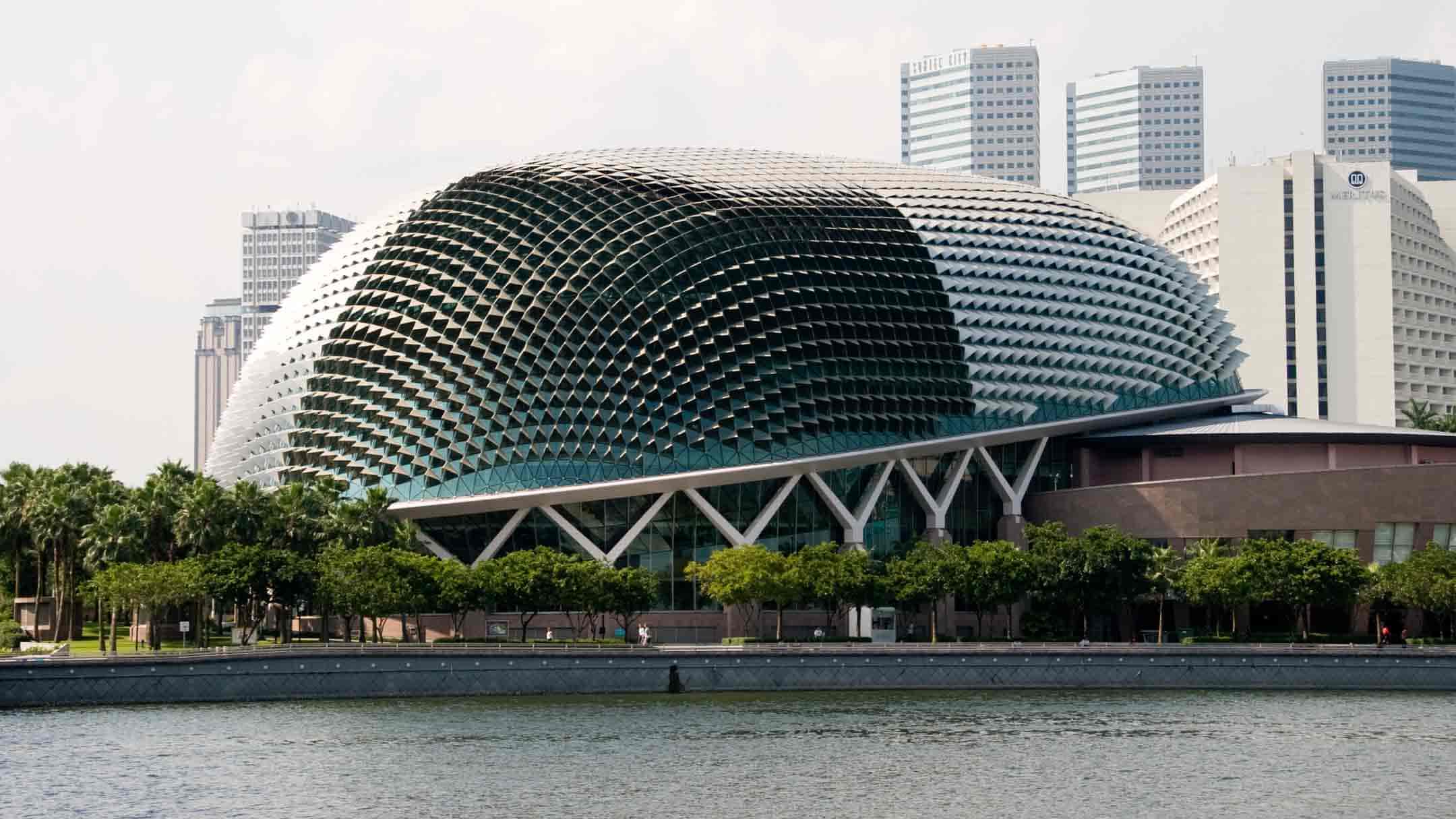
    The Esplanade Theatres on the Bay are built on reclaimed land near the mouth of the Singapore River, on the north shore of Marina Bay. They were finished in 2002, and the building was initially criticised for its expense, and its resemblance to two halves of a durian fruit, or flies eyes.

    Originally designed with a flower-shaped layout, the building design went through a few iterations before ending up resembling the durian fruit we see today. This has resulted in the building being colloquially known as The Durians.

    One of the classic views of the Esplanade Theatres is from the south side of Marina Bay on the riverfront Merlion Park, home of the Merlion statue. Tourist bumboats regularly cruise the Singapore River and Marina Bay so it is worth waiting for one to pass.

    Esplanade Theatres On The Bay, from Merlion Park on the south side of Marina Bay, Singapore
    Esplanade Theatres On The Bay, from Merlion Park, on south side of Marina Bay, Singapore.
    ©2025 Rick Piper Photography. View a hi-res version of this image at rpphotoz.com
    Tourist boat on the Singapore river near the Esplanade Theatres On The Bay, Marina Bay, Singapore
    Tourist boat near the Esplanade Theatres On The Bay, Marina Bay, Singapore.
    ©2025 Rick Piper Photography. View a hi-res version of this image at rpphotoz.com

    The spikes on the two domed roofs consist of over 7000 triangular aluminium panels forming passive solar sunshades fixed to the double-glazed space-framed roofs of the two main performance venues, a concert hall and a theatre. They are designed to maximise natural light and to block out the tropical heat by stopping the sun’s rays hitting the glass. Without the sunshading devices the two domes would have performed like giant greenhouses in Singapore’s tropical climate.

    The building was not designed to look like two half durians, it just evolved that way. That confluence of unique design and passive thermal performance results in a building with many photographic possibilities. It looks good from just about any angle, and the spiky sunshades offer many geometric patterns.

    The Y-shaped structural supports on the perimeter of the domed roofs, besides being part of the structure, also channel rainfall runoff from the roof to underground water storage tanks. This water is used both for cleaning the sunshades and glass, and for irrigating the extensive planting around the theatres.

    Esplanade Theatres On The Bay, Marina Bay, Singapore
    Esplanade Theatres On The Bay, Marina Bay, Singapore.
    ©2025 Rick Piper Photography. View a hi-res version of this image at rpphotoz.com

    Further away, the riverside Queen Elizabeth Walk gives a view of the spiky domes rising above colourful bougainvillea plants.

    Esplanade Theatres on the Bay from Queen Elizabeth Walk, Singapore
    Esplanade Theatres on the Bay from Queen Elizabeth Walk, Singapore.
    ©2025 Rick Piper Photography. View a hi-res version of this image at rpphotoz.com
    The roof of the Esplanade Theatres on the Bay, the Cavenagh Bridge, and the city skyline from the Boat Quay, Singapore
    The roof of the Esplanade Theatres on the Bay from the Boat Quay, Singapore.
    ©2025 Rick Piper Photography. View a hi-res version of this image at rpphotoz.com

    [Back to Top]


    If you have a long lens you can shoot some interesting symmetrical geometric patterns from the Esplanade Bridge and the Merlion Park, as well as cityscape skyline photos.

    Roof of the Esplanade Theatres On The Bay, Marina Bay, Singapore
    Roof of the Esplanade Theatres On The Bay, Marina Bay, Singapore.
    ©2025 Rick Piper Photography. View a hi-res version of this image at rpphotoz.com
    Roof of the Esplanade Theatres On The Bay, Marina Bay, Singapore
    Roof of the Esplanade Theatres On The Bay, Marina Bay, Singapore.
    ©2025 Rick Piper Photography. View a hi-res version of this image at rpphotoz.com
    Roof of the Esplanade Theatres On The Bay, Marina Bay, Singapore
    Roof of the Esplanade Theatres On The Bay, Marina Bay, Singapore.
    ©2025 Rick Piper Photography. View a hi-res version of this image at rpphotoz.com
    Roof of the Esplanade Theatres On The Bay, Marina Bay, Singapore
    Roof of the Esplanade Theatres On The Bay, Marina Bay, Singapore.
    ©2025 Rick Piper Photography. View a hi-res version of this image at rpphotoz.com

    [Back to Top]


    At night, the internal lighting causes the spiky domes to softly glow. Shooting across Marina Bay to the Esplanade Theatres from the Esplanade Bridge with a wide-angle lens, you can also capture the Singapore Flyer ferris wheel. Nighttime close-ups of the building also look good.

    Esplanade Theatres On The Bay at night, Marina Bay, Singapore
    Esplanade Theatres On The Bay at night, Marina Bay, Singapore.
    ©2025 Rick Piper Photography. View a hi-res version of this image at rpphotoz.com
    The domed roof of the Esplanade Theatres On The Bay lit up at night, Marina Bay, Singapore
    The Esplanade Theatres On The Bay lit up at night, Marina Bay, Singapore.
    ©2025 Rick Piper Photography. View a hi-res version of this image at rpphotoz.com
    The Esplanade Theatres On The Bay at night, Marina Bay, Singapore
    The Esplanade Theatres On The Bay at night, Marina Bay, Singapore.
    ©2025 Rick Piper Photography. View a hi-res version of this image at rpphotoz.com
    Drum set on the stage of the Esplanade Outdoor Theatre, Esplanade Theatres On The Bay, Marina Bay, Singapore
    Drum kit at the Outdoor Theatre, Esplanade Theatres On The Bay, Marina Bay, Singapore.
    ©2025 Rick Piper Photography. View a hi-res version of this image at rpphotoz.com

    [Back to Top]


    Marina Bay Sands Hotel and the Double Helix Bridge, Marina Bay, Singapore
    Marina Bay Sands Hotel and the Double Helix Bridge, Marina Bay, Singapore.
    ©2025 Rick Piper Photography. View a hi-res version of this image at rpphotoz.com

    The Helix Bridge officially opened in 2010, and was designed by an international consortium of Australian architects and engineers – Cox Architecture and Arup Engineers – and Singapore based architects, and completes the walk around Marina Bay. Overall, The Helix offers endless photographic possibilities with its curving and intertwining form, many leading lines, and interesting structural details.

    From the north end of the bridge you can shoot The Helix with another iconic Singapore building, the Marina Bay Sands Hotel.

    Marina Bay Sands Hotel and the Double Helix Bridge, Marina Bay, Singapore
    Marina Bay Sands Hotel and the Double Helix Bridge, Marina Bay, Singapore.
    ©2025 Rick Piper Photography. View a hi-res version of this image at rpphotoz.com
    The Double Helix Bridge and the Marina Bay Sands Hotel, Marina Bay, Singapore
    The Double Helix Bridge and the Marina Bay Sands Hotel, Marina Bay, Singapore.
    ©2025 Rick Piper Photography. View a hi-res version of this image at rpphotoz.com
    Curved stainless steel tubing on the Double Helix Bridge, Marina Bay, Singapore
    Curved stainless steel tubing on the Double Helix Bridge, Marina Bay, Singapore.
    ©2025 Rick Piper Photography. View a hi-res version of this image at rpphotoz.com
    Curved stainless steel tubing on the Double Helix Bridge, Marina Bay, Singapore
    Curved stainless steel tubing on the Double Helix Bridge, Marina Bay, Singapore.
    ©2025 Rick Piper Photography. View a hi-res version of this image at rpphotoz.com
    Curved stainless steel tubing on the Double Helix Bridge, Marina Bay, Singapore
    Curved stainless steel tubing on the Double Helix Bridge, Marina Bay, Singapore.
    ©2025 Rick Piper Photography. View a hi-res version of this image at rpphotoz.com
    Curved stainless steel tubing on the Double Helix Bridge, Marina Bay, Singapore
    Curved stainless steel tubing on the Double Helix Bridge, Marina Bay, Singapore.
    ©2025 Rick Piper Photography. View a hi-res version of this image at rpphotoz.com
    Detail of stainless steel connections on the Double Helix Bridge, Marina Bay, Singapore
    Stainless steel connections on the Double Helix Bridge, Marina Bay, Singapore.
    ©2025 Rick Piper Photography. View a hi-res version of this image at rpphotoz.com
    Detail of stainless steel connections on the Double Helix Bridge, Marina Bay, Singapore
    Stainless steel connections on the Double Helix Bridge, Marina Bay, Singapore.
    ©2025 Rick Piper Photography. View a hi-res version of this image at rpphotoz.com

    Some sections of the bridge are open to the sky, and other areas are covered with blue-tinted fritted-glass, or white powder-coated perforated steel mesh panels, all connected to the inner spiral of the helix structure, providing some shade for pedestrians. These roof elements are complex and allow for some interesting compositions.

    Blue-tinted fritted-glass roof panels on the curved stainless steel tubing of the Double Helix Bridge, Marina Bay, Singapore
    Blue-tinted fritted-glass roof panels on the curved stainless steel tubing of the Double Helix Bridge, Marina Bay, Singapore.
    ©2025 Rick Piper Photography. View a hi-res version of this image at rpphotoz.com
    Blue-tinted fritted-glass roof panels on the curved stainless steel tubing of the Double Helix Bridge, Marina Bay, Singapore
    Blue-tinted fritted-glass roof panels on the curved stainless steel tubing of the Double Helix Bridge, Marina Bay, Singapore.
    ©2025 Rick Piper Photography. View a hi-res version of this image at rpphotoz.com

    [Back to Top]


    [Back to Top]


    All images in this post were shot in RAW using Nikon cameras bodies, with Nikkor Pro f2.8 lenses, and then processed in Lightroom and Photoshop.

    Most of the shots above were taken with Nikkor 24-70mm f2.8 and 70-200mm f2.8 zoom lenses. I also used a Nikkor 14-24mm f2.8 zoom lens and a Nikkor 105mm f2.8 Micro lens. As this is heavy camera gear, all shots were taken using a tripod and remote trigger.

    All images Copyright ©2025 Rick Piper Photography (unless noted otherwise). All rights reserved.

    [Back to Top]

  • Bayon – Face Towers

    Bayon – Face Towers

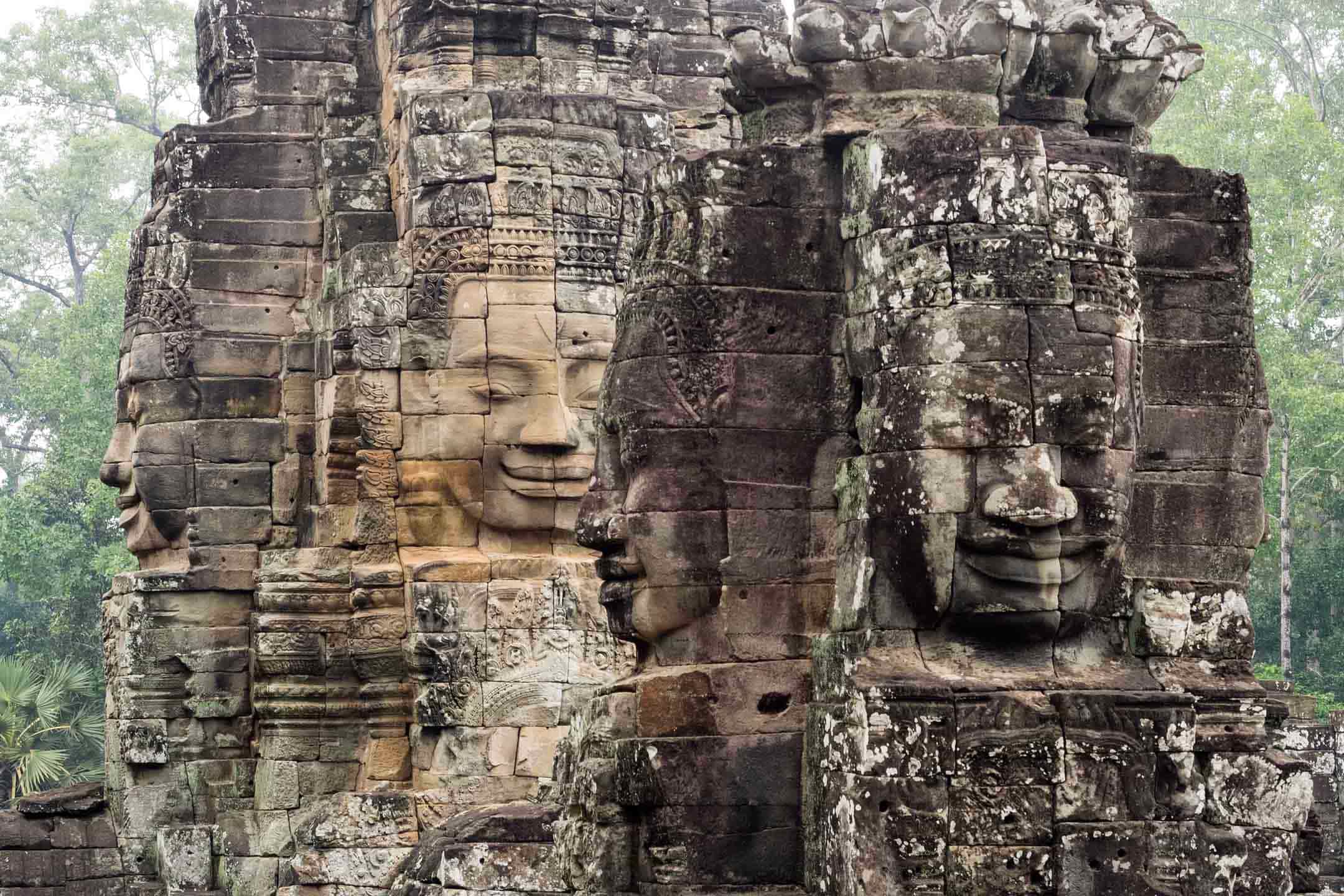
    Enigmatic and gigantic, 173 stone faces adorn the remaining 37 towers on the upper-level cruciform platform. Why are they there, and whose face is it?


    The Bayon Temple is probably the most popular temple visited by tourists in Cambodia’s Angkor Archaeological Park, after Angkor Wat. Located in the exact centre of the ancient city of Angkor Thom, visitors are drawn to the Bayon for its enigmatic, giant stone faces, and its extensive bas-relief carvings. First impressions of the Bayon, though, are not as awe-inspiring as the first glimpses of Angkor Wat.

    Click on the links below to jump to:


    Face towers on the upper level of the Bayon Temple, Angkor Archaeological Park, Cambodia
    Face towers on the upper level of the Bayon Temple, Cambodia.
    ©2025 Rick Piper Photography. View a hi-res version of this image at rpphotoz.com

    On the eastern side of the temple there are two large basins, or ponds, one each on either side of the elevated naga-lined terrace leading to the east gopura, and if you want to get a shot of the temple towers reflected in the water you need to visit either during, or at end of, the rainy season. I have only been to the Bayon in December and January, and most times the basins have been completely dry, or just very small ponds. So, if you want to see the temple reflected in water, try to visit at the end of the rainy season – November, when it may or may not still be raining, rather than December or January.

    Note that the restoration work on the upper level, to repair and make safe the naga balustrades to the edge of the southwestern part of the platform, is now complete and will not affect your visit. Restoration work on the western side of the Bayon is ongoing.

    [Back to Top]


    The Bayon Temple is now known to be a Buddhist temple, and was constructed in the reign of that prolific builder, Jayavarman VII, at the centre of his fortified walled city of Angkor Thom, the ancient capital city of the Angkor empire.

    This was not the first temple to be built in Angkor Thom – the Baphuon Temple was built by Udayadityavarman II around the mid-11th century, about 150 years before the Bayon, and Jayavarman VII included it within the new city walls.

    He built the Bayon exactly at the centre, and placed his kingdom under the protection of Buddha, whose broken statue was found in a pit below the central sanctuary. Most of the extensive bas-reliefs, devatas, and apsaras at the temple are informed by Hindu mythology, as is the temple-mountain form of the temple, so the Bayon presents a mixed religious environment.

    [Back to Top]


    On the 37 towers on the upper-level cruciform platform there are 173 enigmatic, giant stone faces. These stone faces are impressive – more than double the height of a person. There used to be more. How many more is disputed, but there were originally at least 49 towers, and maybe as many as 59, with over 200 faces carved on them – each tower having either four, three, or two faces each.

    So whose face is it? This has also been much disputed over the years, but all experts agree that it is not the Buddha – sometimes the identity of choice on internet images.

    The Chinese emissary Zhou Daguan, in the late 13th century, described them as large Buddha heads. Centuries later, the first European visitors thought the faces were of Brahma, the four-faced god of Hindu mythology. Some scholars thought the faces represented Shiva. It was also suggested that the faces depicted King Jayavarman VII, presenting himself as a god-king, but that thinking has been superseded.

    When it was finally established that the Bayon was a Buddhist temple, it was generally thought that the faces on the Bayon and the Angkor Thom entry gates were of Lokeshvara, the Bodhisattva of compassion, but not all scholars accepted that the faces represented the Bodhisattva. Later, Japanese researchers identified that not all faces had male features, some were female, and that there were three different types of faces representing devas, devatas, and asuras. Lastly, another proposal was that the faces represented the Bodhisattva Vajrasattva.

    We will probably never know who the faces represent – they will forever remain an enigma. As Michel Petrotchenko says about the identity of the faces in his guidebook:

    The fact of the matter is that we will probably never know. The deity of the Bayon will keep on smiling, knowing that the question of its identity will forever remain a mystery. Undeterred by our speculations, the god will continue to spread its compassion and its protection over the provinces of a now defunct empire.

    Petrotchenko, M (2017). Focussing on the Angkor Temples: The Guidebook, p. 217. Published by Michel Petrotchenko.

    [Back to Top]


    Face tower on the upper level of the Bayon Temple, Angkor Archaeological Park, Cambodia
    Early morning view of a face tower on the upper level of the Bayon Temple, Cambodia.
    ©2025 Rick Piper Photography. View a hi-res version of this image at rpphotoz.com
    Tourist crowd on the upper level of the Bayon temple, Angkor Archaeological Park, Cambodia
    Mid-morning tourist crowd on the upper level of the Bayon temple, Cambodia.
    ©2025 Rick Piper Photography. View a hi-res version of this image at rpphotoz.com
    Tourists at the South Gate of Angkor Thom, Angkor Archaeological Park, Cambodia
    Early morning tourists at the South Gate of Angkor Thom, Cambodia. Next stop – the Bayon!
    ©2025 Rick Piper Photography. View a hi-res version of this image at rpphotoz.com
    Crowd of tourists viewing the bas-relief carvings at the Bayon temple, Angkor Archaeological Park, Cambodia
    Crowd of tourists viewing the bas-relief carvings at the Bayon temple, Cambodia.
    ©2025 Rick Piper Photography. View a hi-res version of this image at rpphotoz.com

    Tourist numbers ease up a bit around lunchtime, but the lighting is not so good for photographing the faces – the sandstone faces are almost monochrome grey. I have found it a good time to photograph the bas-reliefs, though – the sun overhead creates good shadows that help accentuate the carvings. In the afternoon it gets very busy again until golden hour, when people head off to Angkor Wat, Phnom Bakheng, and Pre Rup to watch the sunset.

    [Back to Top]


    If you want to capture a golden hour shot at the Bayon, like the one below, you need to time it right.

    Giant faces on the upper level of the Bayon temple, Cambodia
    Giant faces on the eastern side of the upper level of the Bayon temple, Cambodia.
    ©2025 Rick Piper Photography. View a hi-res version of this image at rpphotoz.com

    The faces in the image above are on the eastern side of the upper level, and you need to shoot from a position to the south of the central sanctuary – the same faces are on the feature image at the top of this post, but shot mid-morning under an overcast sky, so, very different light. With four faces to choose from, there are a number of different golden hour face combinations available, and there are many versions of this golden hour shot on the internet.

    I had scouted out the shot in the morning, so returned in the afternoon and set myself up next to the south doorway of the central sanctuary, between the building and a square column to my right, camera pointing east to the face towers – there was just enough room for me and my tripod – and waited for the warm glow of golden hour.

    The sandstone really does take on that lovely soft brown glow, but the problem with shooting in golden hour at the Bayon is the surrounding forest – in the last hour before sunset, some of those particular faces will start to have tree shadows encroaching on them. So my advice is to check the time of sunset with an app like The Photographer’s Ephemeris, get into position, and set yourself up about an hour and a half before sunset, or even earlier.

    [Back to Top]


    The other good location for shooting multiple faces, such as the image below, is in the southwest corner of the upper level platform in the morning, shooting northwest to the face towers west of the central sanctuary. In this location you can get a variety of face combinations in the shot. If you have a guide, they will know where to shoot from. If you do not have your own guide, maybe listen-in on a nearby tour group, or, if you have a copy of Michel Petrotchenko’s book, Focussing on the Angkor Temples: A Guidebook, both shooting locations are indicated on the third floor plan (p. 221).

    Face towers on the upper level of the Bayon Temple, Angkor Archaeological Park, Cambodia
    Face towers on the western side of the upper level of the Bayon Temple, Cambodia.
    ©2025 Rick Piper Photography. View a hi-res version of this image at rpphotoz.com
    Giant stone face on a face tower on the upper level of the Bayon Temple, Cambodia
    Giant stone face on a face tower with a golden hour glow to the sandstone, upper level of the Bayon Temple, Cambodia.
    ©2025 Rick Piper Photography. View a hi-res version of this image at rpphotoz.com

    The image to the left was taken around 7:30am, almost two hours after sunrise, and still shows a little of the morning golden hour glow. This face tower is in the western part of the upper level, and faces east.

    Some of the most dramatic images of the faces are close-ups, isolating individual faces against a blue sky or a backdrop of forest greenery, as in the images below. If you are shooting for stock, it is a good idea to allow for some copy-space also. You will need a long lens, but do not worry about tourists getting in the way of your shot – you will be shooting over their heads.

    Giant stone face on a face tower on the upper level of the Bayon Temple, Cambodia
    Giant stone face on a face tower, upper level of the Bayon Temple, Cambodia.
    ©2025 Rick Piper Photography. View a hi-res version of this image at rpphotoz.com
    Giant stone face on a face tower on the upper level of the Bayon Temple, Cambodia
    Giant stone face on a face tower, upper level of the Bayon Temple, Cambodia.
    ©2025 Rick Piper Photography. View a hi-res version of this image at rpphotoz.com
    Giant stone face on a face tower on the upper level of the Bayon Temple, Cambodia
    Giant stone face on a face tower on the upper level of the Bayon Temple, Cambodia.
    ©2025 Rick Piper Photography. View a hi-res version of this image at rpphotoz.com
    Giant stone face on a face tower on the upper level of the Bayon Temple, Cambodia
    Giant stone face on a face tower on the upper level of the Bayon Temple, Cambodia.
    ©2025 Rick Piper Photography. View a hi-res version of this image at rpphotoz.com

    Not all the faces are high up on towers. Some are at a lower level, just above the upper floor level, and consequently, very popular with tourists posing in front of them or taking selfies. If you want a tourist-free shot you may have to set yourself up, wait, and be ready to press that shutter button.

    A giant face on the upper level of the Bayon Temple, Angkor Archaeological Park, Cambodia
    A low-level giant face on the upper level of the Bayon Temple, Cambodia.
    ©2025 Rick Piper Photography. View a hi-res version of this image at rpphotoz.com
    Crowd of tourists in front of a giant stone face on the upper level of the Bayon Temple, Cambodia
    Tourists in front of a giant stone face, upper level, the Bayon Temple, Cambodia.
    ©2025 Rick Piper Photography. View a hi-res version of this image at rpphotoz.com
    Tourist posing in front of a giant face on the upper level of the Bayon Temple, Angkor Archaeological Park, Cambodia
    Tourist posing in front of a giant face on the upper level of the Bayon Temple, Cambodia.
    The immense size of the face can be seen by the chin in the top left of the image.
    ©2025 Rick Piper Photography. View a hi-res version of this image at rpphotoz.com

    Some of the low-level faces are popular because they can be viewed through window openings in the vestibules, such as below. However, you may need to wait for a tourist-free shot through the window. You may also need to wait until no one is posing in the window with the face in the background – a very popular shot to post on social media.

    Giant stone face viewed through a vestibule window opening on the upper level of the Bayon Temple, Cambodia
    Giant stone face viewed through a vestibule window opening on the upper level of the Bayon Temple, Cambodia.
    ©2025 Rick Piper Photography. View a hi-res version of this image at rpphotoz.com
    Giant stone face viewed through a vestibule window opening on the upper level of the Bayon Temple, Cambodia
    Giant stone face viewed through a vestibule window opening on the upper level of the Bayon Temple, Cambodia.
    ©2025 Rick Piper Photography. View a hi-res version of this image at rpphotoz.com

    There is usually a small troupe of dancers dressed in traditional Khmer costumes, who are willing to pose with you in front of one of the stone faces, for a price, if that appeals to you. Very popular with some tourists.

    Khmer dancers in traditional costumes on the upper level of the Bayon Temple, Angkor Archaeological Park, Cambodia
    Khmer dancers in traditional costumes on the upper level of the Bayon Temple, Cambodia.
    ©2025 Rick Piper Photography. View a hi-res version of this image at rpphotoz.com

    [Back to Top]


    Take care getting up to the third level – there are steep, narrow, well-worn stone steps, with low headroom near the top if you are tall. Take even more care when descending those steps.

    The steps in the image below left are typical of stone steps everywhere at the Angkor temples, and do not look too bad, but the image lacks a sense of scale – those risers are high, and the steps have very narrow treads. Ascending is relatively easy, if a little strenuous, but descending is definitely not at all easy – the steps look almost vertical when viewed from the top. The image below right shows someone descending those same steps, side on, and very carefully. Not for the feint-hearted, for sure!

    Steep stone steps to the upper level of the Bayon Temple, Cambodia
    Steep stone steps at the Bayon Temple, Cambodia.
    ©2025 Rick Piper Photography. View a hi-res version of this image at rpphotoz.com
    Tourist descending the steep stone steps to the upper level of the Bayon Temple, Cambodia
    Tourist descending steep stone steps at the Bayon Temple, Cambodia. ©2025 Rick Piper Photography. View a hi-res version of this image at rpphotoz.com

    [Back to Top]


    Getting good shots of the faces at the Bayon Temple takes a bit of planning and time, so I hope you have found the advice above helpful. It definitely pays to plan ahead and slow down.

    If you have never visited the temples at Angkor, you may find the following three posts useful as an introduction:

    Angkor Wat Temple surrounded by jungle, viewed from Phnom Bakheng, Cambodia

    Historical overview and clarification

    Practical advice

    General advice for photographers, and resources

    [Back to Top]


    All images in this post were shot with a variety of cameras, either:

    • Using Fuji Sensia transparency film in Olympus OM1 cameras, with Zuiko lenses – transparencies were then scanned using a Nikon ED5000 film scanner and processed in Photoshop
    • Or, shot in RAW using digital Nikon camera bodies, with Nikkor Pro f2.8 lenses, and then processed in Lightroom and Photoshop.
    • Or, shot in RAW using digital Olympus OMD camera bodies, with Zuiko PRO f2.8 lenses, and then processed in Lightroom and Photoshop.
    • Or, shot in RAW using a digital Panasonic camera body, with a Panasonic 20mm f1,8 lens, and then processed in Lightroom and Photoshop.

    All images Copyright ©2025 Rick Piper Photography (unless noted otherwise). All rights reserved.
    [Back to Top]

  • Angkor Temples – Part 3

    Angkor Temples – Part 3


    Part 3 – use the links below to jump to:


    This is some general advice concerning photography at the Angkor temples – what you are allowed to do, or not. I will give more specific advice in future posts on individual temples.

    If you want to shoot a movie or commercial anywhere in or around the temples of the Angkor Archaeological Park you need to get permission, and pay a fee. The same applies for video and photo shoots for YouTube, music videos, entertainment programs, documentaries, commercials, guidebooks, catalogues, and magazines intended for local or international distribution.

    [Back to Top]

    Official news organizations, both domestic and international, must apply for permission, but are exempt from fees when conducting coverage for informational purposes.

    [Back to Top]

    Special permissions or fees do not apply to personal photography. This includes pre-wedding and cultural-dress photo shoots for personal use, although a commercial wedding shoot would require permission.

    Cambodian bride in traditional dress at the Bayon temple, Angkor Archaeological Park, Cambodia
    Cambodian bride in traditional dress at the Bayon temple, Cambodia.
    ©2025 Rick Piper Photography. View a hi-res version of this image, and more, at rpphotoz.com

    I’ve seen a few tourists doing personal “fashion shoots”, having brought along a bag of clothes to change into. Obviously, a commercial fashion shoot would require permission.

    Note that flash photography is banned everywhere at the Angkor temples.

    [Back to Top]

    There are no restrictions on using tripods at the Angkor temples for personal photography. In 2022 there was some confusion, with claims that the Apsara National Authority (ANA) had announced a ban on the use of tripods without paying for permission to do so. This was later clarified by the ANA, which was merely trying to point out that commercial photo shoots (often using tripods, but also lights, reflectors, etc.) need to pay.

    If you do use a tripod, be sure not to block the main paths or become a safety hazard for other visitors, or look like a pro on a commercial shoot!

    [Back to Top]

    The use of drones is banned at Angkor, unless you have permission and pay a fee. Also not permitted are the use of GoPro cameras, Insta 360 cameras, or 360-degree and 180-degree view cameras.

    There are prominent signs at the temples depicting these restrictions, and if you do not have permission you risk permanent drone/camera confiscation, fines, and possible detention while your case is being sorted out. Needless to say, you will not be very popular with the authorities.

    Having said that, and although it is illegal to fly a drone at the Angkor temples, or even for a few miles around the temples, there is a lot of Angkor drone footage on the internet, so if you have recent experience of flying a drone over the Angkor temples, please leave a comment below (anonymously if you wish!) and I will update this post accordingly.

    [Back to Top]

    Forbidden Photography Zones

    Besides a general ban on flash photography everywhere at the temples, there are some restrictions on what you are allowed to photograph.

    You cannot take photos inside the sanctuaries on the 3rd level of Angkor Wat, at archaeological dig sites, in active restoration work sites, at guard stations, or at any official buildings.

    [Back to Top]


    To get the most out of a visit to the Angkor Archaeological Park you will need a guidebook. If you only buy one guidebook to the Angkor temples, and there are many to choose from, I would recommend:

    Focusing on the Angkor Temples – The Guidebook, by Michel Petrotchenko

    I have bought many other guidebooks to the temples over the years, but none of them are as good to carry around as this one. It’s full of maps, plans, and photos, and is very detailed. It’s printed on glossy paper with a flexibound cover. This is, without a doubt, the ultimate Angkor temple guidebook to carry with you.

    I cannot recommend this guidebook highly enough, just buy it! You will not regret it.

    It was first published in 2011, then republished again in 2012 and 2014, and the fourth edition in 2017, which is the one I have. The last copy I bought cost US$25, from the Siem Reap Book Center, next to the U-Care Pharmacy opposite Pub Street, in 2020 just before the COVID pandemic lock-downs. If you see it for sale in Siem Reap and Phnom Penh bookshops, or at the temples, please let me know where and how much in the comments below, and I’ll update this post.

    Another option is to buy some of the five Kindle extracts from the print edition, in the Focussing on Angkor: The Guidebooks e-book series:

    • Khmer History in Angkor Times (2015)
    • Khmer Religion in Angkor Times (2015)
    • Angkor Temples and Architecture (2015)
    • Angkor Wat (2015)
    • The Bayon (2016)

    These are currently available to download from Amazon USA, Amazon UK, and Amazon Australia

    [Back to Top]


    Here are some useful resources for researching the Angkor temples. Many of these books are available to purchase in Siem Reap and Phnom Penh bookshops, and the popular titles are often sold by hawkers at the Angkor temples.

    Alternatively, buy online before your visit, especially if you have limited time at the temples and want to be sufficiently informed before your trip. I bought copies of all the books listed below in Siem Reap, mostly from the Siem Reap Book Center, next to the U-Care Pharmacy opposite Pub Street.

    • Cultural Travel Guides: The Treasures of Angkor
      • Albanese, M. (2006). White Star Publishers. This book, by Italian freelance journalist and Sanskrit/Indology scholar Marilia Albanese, has a good introduction to Khmer culture, religion, and architectural styles. Each temple has detailed floor plans and very good photos. Worth reading to plan what to see before visiting the temples.
    • The Angkor Guidebook: Your Essential Companion to the Temples
      • Booth, A. (2016). ABOUT Asia Travel. This small hardback book, complete with slip case, is more of a coffee table book than a guidebook to carry around at the temples. Containing excellent information, photos, and historical illustrations and photos, this book also has 21 full colour virtual temple restorations, by Bruno Lévy. Printed on clear overlays to photos of the temples as they are today, they show what these ruined temples would have looked like in their heyday. A beautiful book to own for research before your trip, or a great souvenir to remember the temples by.
    • A History of Cambodia
      • Chandler, D. (2008). Westview Press. This book, by Australian history professor David Chandler, covers the history of Cambodia from pre-Angkor times to the end of the twentieth century. Essential background information to the history of the Angkor period, but also to the general history of Cambodia – useful for understanding the tragic history of recent times.
    • Ancient Angkor
      • Freeman, M., & Jacques, C. (2006). Thames & Hudson Ltd. Originally published in 1999, and then revised and republished in 2003, this is an excellent guide written by French scholar Claude Jacques, with detailed floor plans, and photos by Michael Freeman. An interesting aspect of this book are the photos – many taken in the 80s and 90s. Freeman was the first photographer allowed prolonged access to the temples after two decades of war, genocide, and civil war. Consequently, the temples are shown with vegetation spouting out of the stonework as a result of neglect due to war, but since cleaned up, which is what we see today. It would have been great to see the temples as Freeman saw them.
    • National Geographic: Angkor Wat – Access 360 World Heritage
      • National Geographic (2013). History documentary [YouTube]. An interesting 22-minute documentary about new discoveries at Angkor using LiDAR mapping technology for aerial archaeology. Using this technology, structures hidden by the jungle for centuries become visible and can be located on the ground.
    • National Geographic: Engineering the Impossible – Angkor Wat
      • National Geographic (2007). History documentary [DVD]. This 50-minute documentary examines the period of Khmer history when Angkor Wat was built. It covers the construction methods and engineering of the temple, and the vast infrastructure of waterways, farmland, and people required to achieve it. Archaeologists in the documentary posit that Angkor Wat, being permanently surrounded by a moat for centuries, is actually “floating” on saturated subsoil and therefore was not subjected to the expansion and contraction of the subsoil caused by the annual wet and dry seasons, and so avoided the collapse experienced by many other temples.
    • Angkor: Celestial Temples of the Khmer Empire
      • Ortner, J. (2002). Abbeville Press. This is a book of Angkor temple photos by photographer Jon Ortner, with captions by several authors, and detailed sections on history, religion, culture, the Angkorean calendar, architecture, conservation, geography, and hydrology, also written by contributing authors. It includes Angkor temples in Thailand, too. This is a good book for researching Angkor and working out what to see, but not really a guidebook to carry around like Petrotchenko’s guide.
    • The Mekong: Turbulent Past, Uncertain Future
      • Osborne, M. (2001). Grove Press. The history of the Mekong River over the last 2000 years, including its importance in the rise of the Khmer empire of Angkor.
    • Southeast Asia: An introductory History
    • Focussing on the Angkor Temples: The Guidebook
      • Petrotchenko, M. (2017). (4th ed.). Michel Petrotchenko (Pub.) If you only want to buy one guidebook to the temples at Angkor, Petrotchenko’s book is probably the best. The floor plans are excellent and clearly marked with the features not to miss, and there are many photos. History, chronology of Angkorean kings, religion, architectural features – it’s all covered. I have found it to be the best guidebook to carry around at the temples.
    • Angkor: Cambodia’s Wondrous Khmer Temples
      • Rooney, D. (2011). (6th ed). Odyssey Guides. A very good guide to the Angkor temples, including extensive historical background, and coverage of restoration, culture, religion, and architecture, by art historian, Dawn Rooney. Good photos and information on individual temples, with basic floor plans – not as good as the floor plans in Petrotchenko’s guidebook – but, at just under 500 pages, and weighing 860gms (1.9 lbs) it is not really a book you would carry around all day. Excellent for research, though.
    • Angkor: Why an Ancient Civilisation Collapsed
      • Stone, R. (2009, July). National Geographic. The article is also known as Divining Angkor on the National Geographic website, if you are a subscriber. It discusses how the city of Angkor may have engineered its own downfall. If you can obtain a copy of the print magazine it also included a large supplemental map, Southeast Asia: Monsoon Latitudes, on the reverse of which is an excellent graphic of the Khmer empire with photos, illustrations and a historical timeline.
    • Angkor Wat: The Ancient Mystery Of Cambodia’s Lost Capital – City of the God-Kings
      • Timeline (2017). History documentary [YouTube]. A 50-minute documentary, with a somewhat misleading title, examining the history of the city of Angkor, the Angkor kingdom, and Khmer culture – not just Angkor Wat as the title suggests – and uses satellite imagery and LiDAR mapping to further understand how this great empire evolved. Includes some photos from the 19th century, and early film – what you see now is nothing like what was discovered in the 1860s!
    • There are sections on the temples at Angkor in various travel guidebooks, such as Lonely Planet, Rough Guides, and DK Eyewitness Travel, although they are usually brief, have few photos, and lack detailed floor plans.

    [Back to Top]


    If you are a keen photographer visiting the Angkor temples, the last advice I would give is to plan ahead – read Petrotchenko’s guidebook, and carry it with you – try not to look like a pro, and most importantly, slow down.

    Research into the temples will pay off when you find yourself in the right place at the right time, and if you want your visit to the Angkor temples to be rewarding, it’s probably a good idea to inform yourself about:

    • The architecture and construction of the temples – what the various building features are, and their function. Then you will know what the guidebooks are talking about.
    • A knowledge of Hindu and Buddhist mythology, which informs a lot of the building designs and the stories carved in stone (particularly the bas-reliefs), so you know what you are looking at.
    • The geopolitics of ancient SE Asia, which led to frequent wars with the neighbouring Cham and Siamese kingdoms over several centuries. There is a reason for so many bas-relief scenes of battles and war elephants!

    With increased knowledge, you will probably find yourself spending longer at the temples, and really appreciating the skills of the ancient builders and stonemasons.

    Slowing down means you can afford to wait for the perfect shot, the “hero” shot. I’ve seen many tourists rushing around grabbing shots at as many temples as they can visit in a day – a visual record of their trip. Maybe they have limited time, or minimal interest in the history and mythology, and quick grab shots will suffice, but if you want to capture really good images, I would advise you to be informed about what you are photographing, and importantly, slow down.

    There are hundreds of tourists at the popular temples, so you need to be prepared to wait if you are hoping for a tourist-free shot. It is a valid concern, because, for some of my images I have had to wait 30 or 40 minutes to get the shot, and in some cases the tourist-free window was only one or two seconds! Be ready to press that shutter button!

    Tourists at the "Tomb Raider" tree in Ta Prohm temple, Angkor Archaeological Park, Cambodia
    Tourists at the “Tomb Raider” tree in Ta Prohm temple, Cambodia. ©2025 Rick Piper Photography. View a hi-res version of this image, and more, at rpphotoz.com
    Tourist crowd on the upper level of the Bayon temple, Angkor Archaeological Park, Cambodia
    Tourist crowd on the upper level of the Bayon temple, Cambodia. ©2025 Rick Piper Photography. View a hi-res version of this image, and more, at rpphotoz.com

    The Bayon and Ta Prohm temples get particularly busy, especially if you want a shot of the “Tomb Raider” tree – any tree roots, actually – or an enigmatic stone face. If you want to avoid being part of the crowds, like in the images above and below, try to arrive early, when many tourists will be eating breakfast in their hotels.

    Crowd of tourists at the "Tomb Raider" tree in Ta Prohm temple, Angkor Archaeological Park, Cambodia
    Crowd of tourists at the “Tomb Raider” tree in Ta Prohm temple, Cambodia.
    ©2025 Rick Piper Photography. View a hi-res version of this image, and more, at rpphotoz.com

    Sometimes, the wait for a tourist-free shot of the tree roots at Ta Prohm temple is so long that the tourists become the subject!

    Tourists posing in front of tree roots at Ta Prohm temple, Angkor Archaeological Park, Cambodia
    Tourists posing in front of tree roots at Ta Prohm temple, Cambodia.
    ©2025 Rick Piper Photography. View a hi-res version of this image, and more, at rpphotoz.com

    If you are not able to avoid the crowds, Lightroom may be a solution. The latest (June 2025) versions of Lightroom Classic (14.4), and Lightroom (8.4) now include “AI people removal”. I have not tried it, but it could significantly reduce your waiting times to get perfect shots. If you have used this LR feature please leave a comment – I would be very interested to know how successful it is, particularly with complex backgrounds or crowd scenes, like those above.

    [Back to Top]


    • Angkor Wat – Sunrise and Sunset
      • Is it worth the effort, and the waiting, for what may be slightly disappointing, or even underwhelming?
    • Frame the Shot
      • Using the technique of hard and soft framing to emphasise architectural features.

    [Back to Top]


    All images in this post were shot either:

    • Using Fuji Sensia transparency film in Olympus OM1 cameras, with Zuiko lenses – transparencies were then scanned using a Nikon ED5000 film scanner and processed in Photoshop
    • Or, shot in RAW using digital Nikon camera bodies, with Nikkor Pro f2.8 lenses, and then processed in Lightroom and Photoshop.
    • Or, shot in RAW using digital Olympus OMD camera bodies, with Zuiko PRO f2.8 lenses, and then processed in Lightroom and Photoshop.

    [Back to Top]

  • Angkor Temples – Part 1

    Angkor Temples – Part 1


    Cambodia is a popular tourist destination, which has been driven, historically, by the desire to visit the Angkor temples. However, visitor numbers to the Angkor temples in the last few years have actually decreased.

    During the Covid pandemic, visitor numbers to the temples, and Cambodia generally, were very low, but since the end of the pandemic, and although international tourist arrivals to Cambodia have increased, the proportion visiting the Angkor temples have decreased.

    Much of this decline can be attributed to the disappearance of Chinese visitors, which is bad news for tourism businesses around Siem Reap, but good news for tourists, with less crowding at the popular temples.

    Chinese visitor numbers are increasing, though. I read recently that Chinese visitors have increased over 40% this year (2025), compared to last year (2024), admittedly from a low base post-pandemic, but now placing visitors from China third, after Thailand and Vietnam – they used to be first.


    Part 3 – general advice for photographers, and resources:


    [Back to Top]


    Building collapse at Ta Prohm temple.
    ©2025 Rick Piper Photography. View a hi-res version of this image at rpphotoz.com
    Detail of intricately carved sandstone pediment, Banteay Srei temple. ©2025 Rick Piper Photography. View a hi-res version of this image at rpphotoz.com
    Angkor Wat temple silhouetted against a cloudy sky at sunrise, Cambodia
    Angkor Wat temple at sunrise.
    ©2025 Rick Piper Photography. View a hi-res version of this image at rpphotoz.com

    [Back to Top]


    Angkor Wat temple viewed from the south-west.
    ©2025 Rick Piper Photography. View a hi-res version of this image at rpphotoz.com
    Angkor Wat temple reflections. ©2025 Rick Piper Photography. View a hi-res version of this image at rpphotoz.com
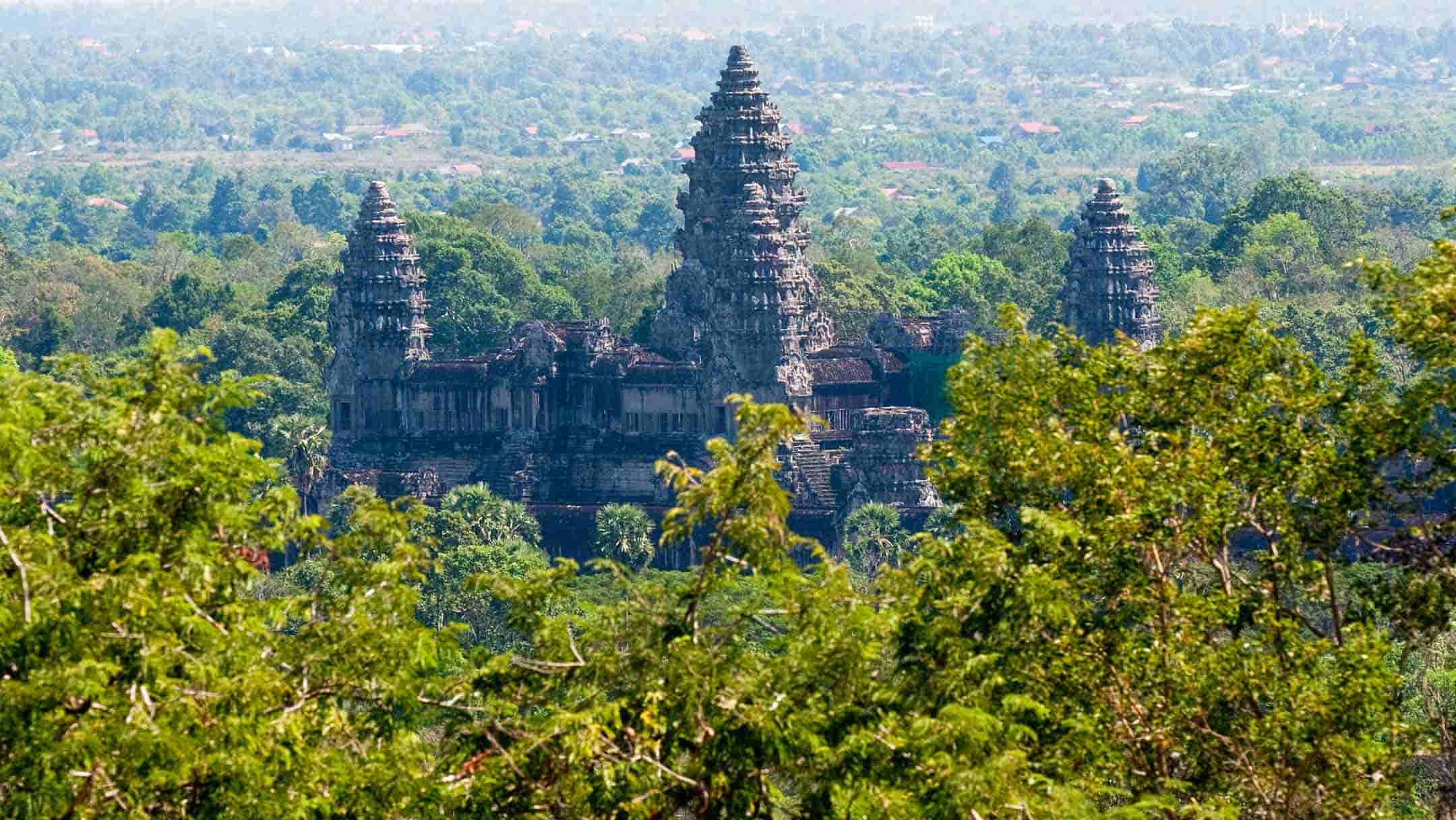
    Angkor Wat temple surrounded by jungle, viewed from Phnom Bakheng.
    ©2025 Rick Piper Photography. View a hi-res version of this image at rpphotoz.com

    [Back to Top]


    Angkor Thom North Gate face tower, viewed from the south. Not Angkor Wat! ©2025 Rick Piper Photography. View a hi-res version of this image at rpphotoz.com
    Forest path on top of the walls of Angkor Thom, Angkor Archaeological Park, Cambodia
    Forest path along the top of the walls to the ancient city of Angkor Thom, Cambodia
    ©2025 Rick Piper Photography. View a hi-res version of this image at rpphotoz.com
    Northern face of the Angkor Thom East Gate. This is in the ancient city of Angkor Thom, not at Angkor Wat!
    ©2025 Rick Piper Photography. View a hi-res version of this image at rpphotoz.com
    Giant face on the upper level of the Bayon temple.
    ©2025 Rick Piper Photography. View a hi-res version of this image at rpphotoz.com
    Giant faces on the upper level of the Bayon temple.
    ©2025 Rick Piper Photography. View a hi-res version of this image at rpphotoz.com
    Giant stone face on the face tower of the eastern entry gopura at Banteay Kdei Temple, Cambodia
    Giant stone face on the face tower of the Banteay Kdei Temple, Cambodia.
    ©2025 Rick Piper Photography. View a hi-res version of this image at rpphotoz.com

    At the centre of Angkor Thom is the Bayon temple, famous for its many face towers, carved with enigmatic, giant stone faces, shown in the two images above.

    In addition to the face towers at the Bayon temple and the Angkor Thom entry gates, there are face towers at other temples, usually on the main entry gates in the outer enclosure walls – such as at Ta Prohm, Banteay Kdei, Ta Som, and Banteay Chhmar.

    The image at left is a face on the eastern entry face tower at Banteay Kdei Temple, just across the road from Srah Srang.

    [Back to Top]


    Tree roots growing over Preah Khan temple, but not at Angkor Wat temple. ©2025 Rick Piper Photography. View a hi-res version of this image at rpphotoz.com
    Silk-cotton tree roots on Gopura III at Ta Prohm temple, but not at Angkor Wat!
    ©2025 Rick Piper Photography. View a hi-res version of this image at rpphotoz.com
    Tree roots growing over the “Tomb Raider” doorway, featured in the Tomb Raider movie, at Ta Prohm temple. There are no tree roots like this at Angkor Wat!.
    ©2025 Rick Piper Photography. View a hi-res version of this image at rpphotoz.com
    Tree roots growing over the inner enclosure at Ta Prohm temple, but not at Angkor Wat!.
    ©2025 Rick Piper Photography. View a hi-res version of this image at rpphotoz.com

    [Back to Top]


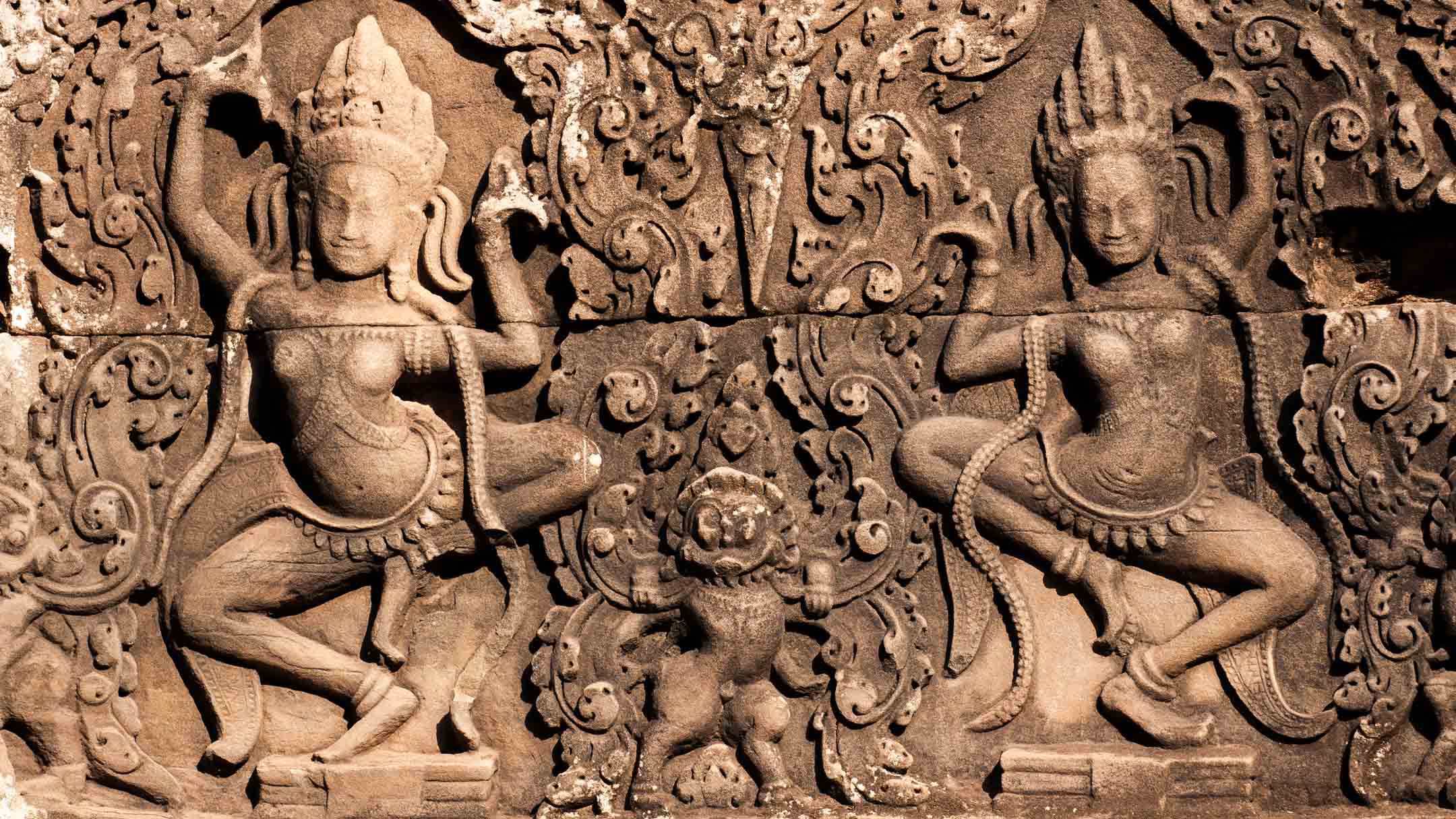
    Apsaras at the Bayon temple, dancing on lotus pads. These are not Devatas!
    ©2025 Rick Piper Photography. View a hi-res version of this image at rpphotoz.com
    Dancing Apsaras at the Bayon temple. These are not Devatas!
    ©2025 Rick Piper Photography. View a hi-res version of this image at rpphotoz.com
    Devatas guarding sanctuaries at the Bayon temple; standing, not dancing. These are not Apsaras! Note the parrot-like bird, lower left, in the bottom right devata image.
    ©2025 Rick Piper Photography. View a hi-res version of this image at rpphotoz.com

    [Back to Top]


    Part 3 contains general photographic advice and some useful resources for researching the temples, including a list of other posts in this series that will address individual temples, listed below, with tips for getting the most out of your visit photographically.

    These blog posts, based on my experiences, may help you get some great images. If there is a hyperlink in the list below, I have published the post. I hope you will be inspired!

    • Angkor Thom – Ancient Khmer City

    [Back to Top]


    All images in this post were shot either:

    • Using Fuji Sensia transparency film in Olympus OM1 cameras, with Zuiko lenses – transparencies were then scanned using a Nikon ED5000 film scanner and processed in Photoshop
    • Or, shot in RAW using digital Nikon camera bodies, with Nikkor Pro f2.8 lenses, and then processed in Lightroom and Photoshop.
    • Or, shot in RAW using digital Olympus OMD camera bodies, with Zuiko PRO f2.8 lenses, and then processed in Lightroom and Photoshop.

    [Back to Top]

  • Blue Skies in Phnom Penh

    Blue Skies in Phnom Penh


    Should your travels take you to Phnom Penh, the capital of Cambodia, and you wake up to a blue sky day – carpe diem! (seize the day!). A clear blue sky will help you capture some stunning images, because, as the old adage says, everything looks better with a blue sky. From editorial travel articles to promotional advertising, blue skies predominate. So, if you want to sell your travel images, or have an eye-catching print on your wall, make the most of blue sky days.

    Instead of going shopping or checking email/blogging in a cafe, consider visiting three landmark destinations in the city.

    Click on the links below to jump to:

    Fortunately, the three destinations are not very far apart, so you can easily walk between them, and, as most of the streets have a number, no name, it is very easy to find your way around.

    The distance from the market to the museum and palace complex is only about 1.5 kms (1 mile), but if you are not up to that walk in 38C temperatures (over 100F) then take a tuk-tuk, rickshaw, or taxi using the Cambodian ride-hailing app, PassApp.

    Download the app onto your phone, activate it, and then it is easy to request a ride. Enter your destination and preferred style of transport in the app – which already knows where you are – and a nearby driver will accept the job. The app will tell you when the driver will get to you – you can see their location on the street map – and most importantly, the app tells you what the fare will be. No more arguing with tuk-tuk drivers over the fare; no more taxi drivers refusing to use the meter (broken!) or taking the long way. The agreed fare is on the app screen.

    If, when I reach my destination, the driver asks for more than the agreed fare, I refuse to pay more, and just pay them the agreed amount – and then report them to PassApp. On the other hand, if the driver is friendly and takes me to my destination without expecting more than the agreed fare, I always tip them extra. This app takes all the hassles out of using tuk-tuks and taxis.


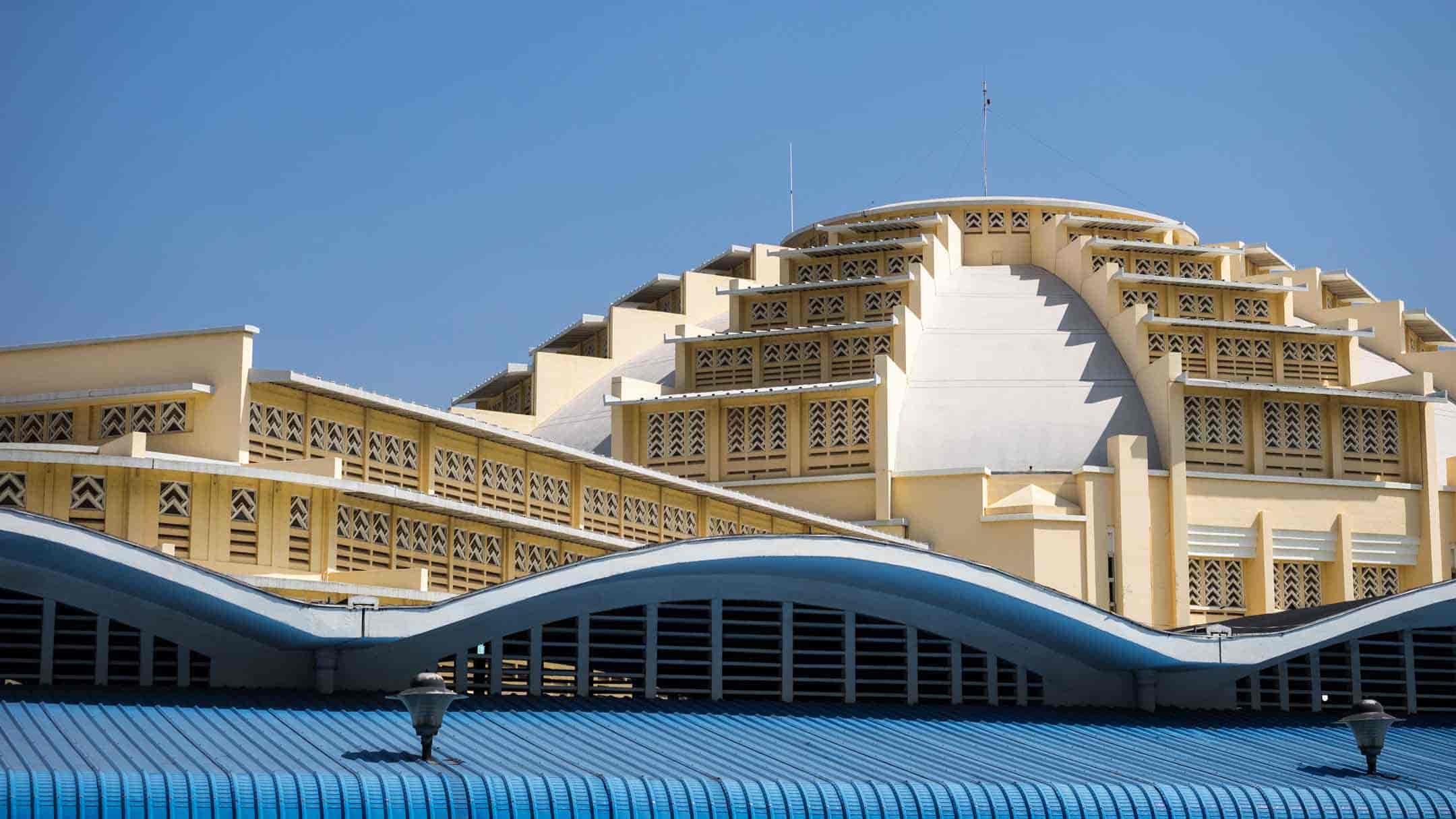
    The first destination is Psar Thmei, the Central Market building, a vast complex of market stalls at the end of St 130, less than a kilometre from the riverfront. The roof-line of this Art Deco building, completed in 1937 and designed by French architect Jean Desbois, features in the image below – the pale yellow roof of the building sandwiched between a blue sky and a blue lower roof.

    Domed roof of the Art Deco style Psar Thmei market building, also known as the Central Market, Phnom Penh, Cambodia
    Domed roof of the Art Deco-style Psar Thmei market building, aka, the Central Market
    ©2025 Rick Piper Photography. View a hi-res version of this image at rpphotoz.com

    The huge open dome, 26 metres high, allows for good ventilation, so even on a very hot day the interior of the building is cool.

    Domed roof of the Art Deco style Psar Thmei market building, also known as the Central Market, Phnom Penh, Cambodia
    Domed roof of the Art Deco-style Psar Thmei market building, aka, the Central Market
    ©2025 Rick Piper Photography. View a hi-res version of this image at rpphotoz.com

    The two images above were taken at different times on different days – the first at 12.50pm, and the second at 3.20pm – so regardless of what time you are there, you can usually get a good shot, because there are four sides and angles to choose from.

    You can also get aerial shots of Psar Thmei market from the nearby Sorya Center Point shopping centre, a few metres south of the market in St 63 – go up to the top floor balcony by taking the lift to the 8th level.

    [Back to Top]


    About 1.5 kms southeast of the Central Market is the National Museum of Cambodia, just north of the Royal Palace complex. To walk there from the Central Market take St 63 south until you reach St 154, turn left and walk east until you reach Norodom Blvd and then head south along the Blvd to St 178, turn left and head east, and then turn right into St 13 – the museum is up ahead.

    The museum buildings, designed by French historian and architect George Groslier, blend traditional Khmer temple architecture shown in the ancient Angkor bas-reliefs, with a French colonial-era reinterpretation, and were constructed between 1917 and 1924 .

    Ornate roofs of the National Museum of Cambodia, Phnom Penh, Cambodia
    Ornate, temple-inspired roofs of the National Museum of Cambodia, Phnom Penh, Cambodia
    ©2025 Rick Piper Photography. View a hi-res version of this image at rpphotoz.com

    The buildings are painted in a combination of reddish-brown terracotta and lighter brown colours, with unglazed clay roof tiles on steeply pitched, multi-tiered roofs with temple-like pointed finials, and carved gable ends.

    Carved gable end of roof at the National Museum of Cambodia, Phnom Penh, Cambodia
    Carved gable end of roof at the National Museum of Cambodia, Phnom Penh, Cambodia
    ©2025 Rick Piper Photography. View a hi-res version of this image at rpphotoz.com

    Four display pavilions surround an inner courtyard, which features lotus ponds, paths, a central pavilion with a Leper King statue, and greenery – combined with a blue sky, these colours can look quite dramatic.

    Ornate, steeply pitched roofs of the National Museum of Cambodia, Phnom Penh, Cambodia
    Steeply pitched roofs of the National Museum of Cambodia, Phnom Penh
    ©2025 Rick Piper Photography. View a hi-res version of this image at rpphotoz.com
    The inner courtyard garden of the National Museum of Cambodia, Phnom Penh, Cambodia
    The inner courtyard garden of the National Museum of Cambodia, Phnom Penh
    ©2025 Rick Piper Photography. View a hi-res version of this image at rpphotoz.com

    The steeply sloping, multi-tiered tiled roofs, curved and pointed, hornlike finials, and carved gable ends make for some interesting compositions, especially with a blue sky as a backdrop. As these features occur on all sides and corners of the building, it is possible to get good lighting at most times of the day.

    My visits have usually been in the early afternoon, but you could visit at most times and get dramatic photos because the courtyard will look good from one side or the other, regardless of the sun’s position – maybe avoid early morning or late afternoon if you want to avoid long shadows. If you are after particular lighting for a feature, maybe check out the Photographer’s Ephemeris, which will give the sun’s location for any time and date.

    The Leper King statue pavilion in the inner courtyard garden of the National Museum of Cambodia, Phnom Penh, Cambodia
    The Leper King statue, inner courtyard of the National Museum of Cambodia
    ©2025 Rick Piper Photography. View a hi-res version of this image at rpphotoz.com

    Centred in the courtyard is a roofed pavilion housing a stone statue of the “Leper King” – not a Buddha statue, and possibly not a leper or king, either! This statue is a copy of the original statue from the Leper King Terrace in Angkor Thom. The original statue was stolen from Angkor Thom, then recovered, and is now displayed inside the National Museum. The statues in the museum courtyard and in Angkor Thom are both copies. To get a photo without the cafe umbrellas in the background, shoot from the cafe side of the courtyard. The Photographer’s Ephemeris can help you work out the best time for that shot.

    Intricately carved sandstone pediment, inner enclosure of Banteay Srei temple, Cambodia
    Detail of intricately carved sandstone pediment, Banteay Srei temple.
    ©2025 Rick Piper Photography. View a hi-res version of this image at rpphotoz.com

    If you have ever wondered how the stonemasons managed to carve foliage so that it looks like stone has been removed from behind the leaves, a very delicate operation with sandstone, examine this pediment closely. As you are not allowed to take photos in the galleries I cannot show you the actual pediment, so the image to the left is an example from the actual Banteay Srei temple. The technique is simple, and often used in deeper bas-relief stone carving – the stone behind the foliage is tapered inwards slightly, which gives the effect of the foliage floating above the stone background.

    Buddha carved on a wooden door of the National Museum of Cambodia, Phnom Penh, Cambodia
    Buddha carved on a wooden door of the National Museum of Cambodia
    ©2025 Rick Piper Photography. View a hi-res version of this image at rpphotoz.com

    Around the exterior of the building are some interesting timber doors – carved with Buddhist iconography and painted black.

    The museum is open from 8am to 5pm every day. Entry fees for foreigners are $10 for adults (18+ years), $5 for 10 to 17 years, free for young children.

    Photography is allowed in the inner courtyard and around the exterior, but no photography is allowed within the museum galleries. There is a cafe inside the building, looking out onto the courtyard, and toilets downstairs.

    [Back to Top]


    Next to the National Museum is the Royal Palace of Cambodia, a complex of buildings that serve as the official residence of the King of Cambodia – the western courtyard is private, containing the King’s private residential villa, so not accessible by tourists. The first palace on this site was constructed by King Norodom between 1866 and 1870, and closely resembled the Grand Palace in Bangkok at that time.

    The Chan Chaya Pavilion in the landscaped grounds of the Royal Palace, Phnom Penh, Cambodia
    The Chan Chhaya Pavilion in landscaped grounds, the Royal Palace, Phnom Penh, Cambodia
    ©2025 Rick Piper Photography. View a hi-res version of this image at rpphotoz.com

    The Chan Chhaya Pavilion, known as the Moonlight Pavilion, next to the enclosing wall on the eastern side of the complex, at the northern end, is particularly impressive. Surrounded by extensive landscaped gardens, and usually with fewer tourists than the Silver Pagoda and Throne Hall, some creative compositions are possible.

    The Chan Chaya Pavilion in the landscaped grounds of the Royal Palace, Phnom Penh, Cambodia
    The Chan Chhaya Pavilion in the landscaped grounds of the Royal Palace, Phnom Penh
    ©2025 Rick Piper Photography. View a hi-res version of this image at rpphotoz.com
    The Chan Chaya Pavilion in the landscaped grounds of the Royal Palace, Phnom Penh, Cambodia
    The Chan Chhaya Pavilion in the landscaped grounds of the Royal Palace, Phnom Penh
    ©2025 Rick Piper Photography. View a hi-res version of this image at rpphotoz.com
    The gold and red roof of the Banquet Hall at the Royal Palace, Phnom Penh, Cambodia
    The gold and red roof of the Banquet Hall, the Royal Palace, Phnom Penh, Cambodia
    ©2025 Rick Piper Photography. View a hi-res version of this image at rpphotoz.com

    The Banquet Hall, also known as the Phochani Pavilion, was built in 1912 and is used for banquets on the King’s birthday. This open-sided pavilion is also not usually as busy with tourists as the Silver Pagoda and Throne Hall, and is surrounded by landscaped gardens.

    The gable ends of the Banquet Hall are richly carved and gilded, with a red background.

    The roof tiles on this building are predominantly red, with green borders, with the red tiles continuing up the spire, which has a gilded finial and highlights.

    The Banquet Hall in the landscaped grounds of the Royal Palace, Phnom Penh, Cambodia
    The Banquet Hall in the landscaped grounds of the Royal Palace, Phnom Penh, Cambodia
    ©2025 Rick Piper Photography. View a hi-res version of this image at rpphotoz.com
    Gilded gable end of the roof of the Banquet Hall at the Royal Palace, Phnom Penh, Cambodia
    Gilded gable end of the roof of the Banquet Hall at the Royal Palace, Phnom Penh, Cambodia
    ©2025 Rick Piper Photography. View a hi-res version of this image at rpphotoz.com
    Detail of gilded timber door at the Royal Palace, Phnom Penh, Cambodia
    Detail of gilded timber door at the Royal Palace, Phnom Penh, Cambodia
    ©2025 Rick Piper Photography. View a hi-res version of this image at rpphotoz.com

    In various locations around the complex you will find some carved, richly-gilded timber doors with red backgrounds. They often have bas-relief-style carvings of foliage, similar to that at temples such as Banteay Srei, in the Angkor Archaeological Park – the seemingly undercut foliage shown in the two images to the left being considerably easier to achieve in wood than in sandstone. Buddhist iconography is also a common theme, as in the image below.

    Detail of gilded timber door at the Royal Palace, Phnom Penh, Cambodia
    Detail of gilded timber door at the Royal Palace, Phnom Penh, Cambodia
    ©2025 Rick Piper Photography. View a hi-res version of this image at rpphotoz.com
    Detail of gilded timber door at the Royal Palace, Phnom Penh, Cambodia
    Detail of gilded timber door at the Royal Palace, Phnom Penh, Cambodia
    ©2025 Rick Piper Photography. View a hi-res version of this image at rpphotoz.com

    The enclosing walls of the Silver Pagoda compound feature ornate gatehouses, such as the image below left. These gatehouses continue the temple design theme on a smaller scale, but still include carved gilded gables, temple-inspired finials, tiled roofs, and gilded spires.

    There are also ornate metal door screens – part of one is shown below right. When I was there, the screens were faced with a clear acrylic sheet, which reflected a lot of glare, requiring some dodging and burning in Photoshop to produce a clear image.

    Ornate roofs to a gatehouse in the enclosing walls to the Silver Pagoda compound at the Royal Palace, Phnom Penh, Cambodia
    Ornate gatehouse roofs in the enclosing walls to the Silver Pagoda compound
    ©2025 Rick Piper Photography. View a hi-res version of this image at rpphotoz.com
    Detail of metal gatehouse door screen in the Silver Pagoda compound at the Royal Palace, Phnom Penh, Cambodia
    Detail of metal gatehouse door screen in the Silver Pagoda compound
    ©2025 Rick Piper Photography. View a hi-res version of this image at rpphotoz.com

    [Back to Top]


    On the cloister walls of the courtyard surrounding the Silver Pagoda is a painted mural of the Ramayana, known as the Reamker in Khmer – the Cambodian version of the epic Sanskrit poem. Over 600 metres long (about 1970 feet), and up to 3.5 metres high (about 11.5 feet), the mural covers about 2000 square metres of wall (about 22,500 square feet). It was painted in the early 1900s, but has been eroded by the weather and micro-organisms, so parts of it are in a poor state.

    The story starts at the right side of the gate in the centre of the eastern cloister wall, and finishes at the left side of the same gate. The narrative is continuously painted as a single panel from beginning to end, with the main scenes separated by vegetation, boulders, or occasionally a river.

    I intend to post a photo essay on the Reamker, but for now, this is a taster of what to expect when you visit the mural at the Royal Palace – which was actually the highlight of the visit for me.

    Detail of the mural depicting scenes from the Reamker, the Khmer version of the classic Sanskrit epic poem, the Ramayana, painted on the gallery walls enclosing the Silver Pagoda compound, at the Royal Palace, Phnom Penh, Cambodia
    Detail of the mural depicting scenes from the Reamker, the Khmer version of the classic Sanskrit epic poem, the Ramayana, painted on the gallery walls enclosing the Silver Pagoda compound, at the Royal Palace, Phnom Penh, Cambodia
    ©2025 Rick Piper Photography. View a hi-res version of this image at rpphotoz.com
    Detail of the mural depicting scenes from the Reamker, the Khmer version of the classic Sanskrit epic poem, the Ramayana, painted on the gallery walls enclosing the Silver Pagoda compound, at the Royal Palace, Phnom Penh, Cambodia
    Detail of the mural depicting scenes from the Reamker, the Khmer version of the classic Sanskrit epic poem, the Ramayana, painted on the gallery walls enclosing the Silver Pagoda compound, at the Royal Palace, Phnom Penh, Cambodia
    ©2025 Rick Piper Photography. View a hi-res version of this image at rpphotoz.com

    [Back to Top]


    The entry fee for foreigners is $10, and you get three hours to view everything – which will probably include queuing to view the interiors of the Silver Pagoda and Throne Hall – and take photos in the landscaped grounds. On a busy day it may not be enough time.

    It seems expensive when you consider that for same amount (on a 7-day visitor’s pass) you can enter the Angkor Archaeological Park, starting at 5am and finishing at 7pm, and view as many temples as you wish within the Park. Maybe what is needed is Cultural Pass for one fee that allows visits to various cultural and historic sites within a designated period – similar to the pass available in Hoi An, Vietnam.

    The opening hours are 8am to 11am, and 2pm to 5pm daily, but note that the complex is closed on most Cambodian public and religious holidays, and may be closed during official royal functions.

    Closing the Royal Palace complex between 11am and 2 pm could be considered fortunate, really – it means you avoid taking photos in the harsh light around midday, although it would be a good time to view the interiors of the Silver Pagoda and Throne Hall.

    All of these images of the Royal Palace were taken on the same afternoon, between 3pm and 4.30pm. At that time of day the shadows are beginning to get longer, so arriving earlier would be better.

    It is worth noting that by mid-afternoon there will be long queues of visitors waiting to go into the Silver Pagoda and Throne Hall – very popular with local Cambodians, especially at weekends – so if seeing the interiors of these buildings is important to you, it may be better to visit in the morning.

    If you decide to visit in the morning my advice would be to enter at 8am and go straight to The Silver Pagoda and/or the Throne Hall to view the interiors – mainly because the sun is lower at this time and the shadows will be longer. After viewing inside, the sun will be higher, with shorter shadows cast – better for photography.

    If you decide to visit in the afternoon my advice would be to enter at 2pm and start taking photos, while the sun is higher and the shadows are shorter. Then, later in the afternoon, as the sun is going down, queue to visit the interiors of the Silver Pagoda and/or the Throne Hall – there may not time for both if you leave it too late, so check the queues as you are shooting.

    Photography is permitted throughout the grounds, but not inside the Silver Pagoda or the Throne Hall – check the signage on the outside of buildings. The 3-hour slots give you plenty of time to explore and take photos, in theory, but be aware that with the restricted opening hours it can get very busy, especially if you want to view the interiors of the Silver Pagoda and Throne Hall.

    [Back to Top]


    [Back to Top]


    Although the emphasis of this blog post has been on making the most of blue sky days, sometimes, buildings with an overcast sky can be dramatic. The image below, taken in Istanbul, was the result of a very small patch of blue sky, in an otherwise totally overcast sky, allowing the sun’s rays to shine on the domes of Rustem Pasa Mosque (at front) and Suleymaniye Mosque – it was all over in about two seconds, so be ready to press that shutter button!

    Late afternoon sun shining on the domes of Suleymaniye Mosque and Rustem Pasa Mosque in an overcast sky, viewed from Eminonu, Istanbul, Turkey,
    Late afternoon sun shining on the domes of Suleymaniye Mosque and Rustem Pasa Mosque in an overcast sky, viewed from Eminonu, Istanbul, Turkeye
    ©2025 Rick Piper Photography. View a hi-res version of this image at rpphotoz.com

    [Back to Top]


    [Back to Top]

  • Chefchaouen Cats

    Chefchaouen Cats


    Blue painted walls and doors in a Chefchaouen street, Morocco
    Blue-painted walls and doors in a Chefchaouen street, Morocco
    ©2025 Rick Piper Photography. View a hi-res version of this image at rpphotoz.com
    Blue painted walls and steps, and pot plants, in a Chefchaouen street, Morocco
    Blue-painted walls and steps, and pot plants, in a Chefchaouen street, Morocco.
    ©2025 Rick Piper Photography. View a hi-res version of this image at rpphotoz.com

    Almost all surfaces – walls, doors, paths, steps – are painted blue, especially indigo and cobalt blue. This is the main reason most tourists visit Chefchaouen. The Chefchaouen medina is similar to other medinas in Morocco, such as Tangier and Tetouan – steep, narrow streets, lots of steps, ornate doorways – except for the preponderance of blue paint. Other medinas use more colours, but Chefchaouen has capitalised on the photogenic appeal of blue paint, everywhere. It is very photogenic – so much so, there are now thousands of images of Chefchaouen on the internet. Maybe millions!

    Blue painted walls and steps in a Chefchaouen street, Morocco
    Blue-painted walls and steps in a Chefchaouen street, Morocco.
    ©2025 Rick Piper Photography. View a hi-res version of this image at rpphotoz.com
    Blue painted buildings in a steep, narrow street in Chefchaouen, Morocco
    Blue painted buildings in a steep, narrow street in Chefchaouen, Morocco.
    ©2025 Rick Piper Photography. View a hi-res version of this image at rpphotoz.com

    Chefchaouen was founded in 1471 by Riffian Berber tribes. It expanded from 1494 with the arrival of Muslim and Jewish refugees from Granada, Spain, who built the typical Hispanic-style whitewashed houses with small balconies, tiled roofs, and enclosed courtyards.

    Have the buildings always been painted blue?

    No, in the 1930s, a new influx of Jewish refugees introduced the blue washes to the buildings. Before that, the buildings were mostly painted white, with green doors and windows – a traditional Muslim colour.

    Blue painted door in a Chefchaouen street, Morocco
    Blue-painted door in a Chefchaouen street, Morocco. ©2025 Rick Piper Photography. View a hi-res version of this image at rpphotoz.com
    Weathered blue painted door in a Chefchaouen street, Morocco
    Weathered blue door in a Chefchaouen street, Morocco. ©2025 Rick Piper Photography. View a hi-res version of this image at rpphotoz.com
    Blue painted door in a Chefchaouen street, Morocco
    Blue-painted door in a Chefchaouen street, Morocco. ©2025 Rick Piper Photography. View a hi-res version of this image at rpphotoz.com

    [Back to Top]


    Cat lovers also go to Chefchaouen, to photograph the stray cats.

    Stray black and white cat in a Chefchaouen street, Morocco

    Stray black and white cat in a Chefchaouen street, Morocco.
    ©2025 Rick Piper Photography. View a hi-res version of this image at rpphotoz.com

    There are stray cats almost everywhere you look in Chefchaouen, relaxing in the streets and doorways by day, and active at night hunting for food.

    Stray cats lounging in a street in Chefchaouen, Morocco
    Stray cats relaxing in a street in Chefchaouen, Morocco
    ©2025 Rick Piper Photography. View a hi-res version of this image at rpphotoz.com

    They are generally tolerated by the locals as they are good ratters and mousers, helping to keep down the vermin population in the medina, but they are not really treated like pets. They do, however, make good subjects for photography, especially with blue walls as backgrounds.

    Stray cat in a blue painted Chefchaouen street, Morocco
    Stray cat in a blue-painted Chefchaouen street, Morocco.
    ©2025 Rick Piper Photography. View a hi-res version of this image at rpphotoz.com

    [Back to Top]


    Stray cat in a blue painted Chefchaouen street, Morocco
    Stray cat in a blue-painted Chefchaouen street, Morocco.
    ©2025 Rick Piper Photography. View a hi-res version of this image at rpphotoz.com

    Unfortunately, some of the cats are in a dire state – thin, mangy, diseased, and with eye infections. I know it is very tempting, but if you like stroking cats, I would be very wary in Chefchaouen. Rabies is endemic in Africa, including Morocco, and most government travel advisories advise against contact with feral animals. Rabies in Morocco is mostly carried by dogs, but cats can also be carriers, so avoid being scratched or bitten. Do not end up like this unfortunate tourist, who died in June 2025 after contracting rabies as the result of a scratch from a stray puppy whilst on holiday in Morocco four months previously.

    Rabies is serious. As the Travelvax Australia website says: “Rabies is almost always fatal and treatment is supportive – there is no cure” [my emphasis]. The website also states:

    While the most common way for humans to become infected with the rabies virus is through a bite, it can also occur through non-bite direct contact with the saliva or brain/nervous system tissue of an infected animal: this may be via a scratch if the animal had licked its claws, or from a lick to an open wound, or through contact with the mucous membranes of the mouth, nose or eyes. (Travelvax Australia website, 2023)

    Most of the cats I photographed looked healthy – that is why I chose them as subjects, although I did keep my distance, and shot with a long lens – but there were many other cats that did not look healthy.

    Stray cat in a blue painted Chefchaouen street, Morocco
    Stray cat in a blue-painted Chefchaouen street, Morocco.
    ©2025 Rick Piper Photography. View a hi-res version of this image at rpphotoz.com
    Stray cat in a blue painted Chefchaouen street, Morocco
    Stray cat in a blue-painted Chefchaouen street, Morocco.
    ©2025 Rick Piper Photography. View a hi-res version of this image at rpphotoz.com
    Stray cat in a blue painted Chefchaouen street, Morocco
    Yawning stray cat in a blue-painted Chefchaouen street, Morocco.
    ©2025 Rick Piper Photography. View a hi-res version of this image at rpphotoz.com

    The cats are easy to photograph, not being too perturbed by humans. They mostly ignore us – unless you invade their space, or threaten them in any way.

    Stray cat in a blue painted Chefchaouen street, Morocco
    Stray cat in a blue-painted Chefchaouen street, Morocco.
    ©2025 Rick Piper Photography. View a hi-res version of this image at rpphotoz.com
    Stray cat in a blue painted Chefchaouen street, Morocco
    Stray cat in a blue-painted Chefchaouen street, Morocco.
    ©2025 Rick Piper Photography. View a hi-res version of this image at rpphotoz.com

    Taking photos can seem threatening to a feral cat if you try to get too close, and some of them can be aggressive. I obviously got a bit too close to the black cat below, who first gave me an angry look, and then an aggressive snarl! So, best to keep your distance and use a long lens.

    Angry looking stray cat in a blue painted Chefchaouen street, Morocco
    Angry looking black cat in Chefchaouen, Morocco. Do not get too close!
    ©2025 Rick Piper Photography. View a hi-res version of this image at rpphotoz.com
    Fierce looking stray cat in a blue painted Chefchaouen street, Morocco
    Aggressive stray black cat in Chefchaouen, Morocco. Do not get too close!
    ©2025 Rick Piper Photography. View a hi-res version of this image at rpphotoz.com

    In one of the main streets of souvenir shops I met a foreigner who lived in Chefchaouen, who was busy putting antibiotic eye drops – bought from a local vet – into the eyes of any cats he could grab, especially the kittens. Altruistic, I know, but highly risky, considering the risk of contracting rabies from a scratch or bite!

    Stray kitten in a Chefchaouen street, Morocco
    Stray kitten in a Chefchaouen street.
    ©2025 Rick Piper Photography. View a hi-res version of this image at rpphotoz.com
    Stray kitten in a Chefchaouen street, Morocco
    Stray kitten in a Chefchaouen street.
    ©2025 Rick Piper Photography. View a hi-res version of this image at rpphotoz.com

    He pointed dismissively to a pile of food put out for the cats. He was complaining, because the food was basically kitchen scraps, including egg shells and orange peel. Not only was most of it inedible, but it looked unsightly in a main street of souvenir shops.

    [Back to Top]


    In Istanbul there are also many stray cats – so well known you can buy postcards of them – but they look healthier. I have seen home-made cat houses, or cat boxes, built against walls to provide shelter, particularly from the rain and snow in winter. Also, feeding stations with bowls for fresh water and dry, crunchy cat food. The image below shows cat houses – basic shelters – in Istiklal Caddesi, one of the main shopping streets in Istanbul.

    Cat houses in the doorway of the abandoned Art Nouveau Botter House, Istiklal Caddesi, Istanbul, Turkeye, Turkey
    Simple cat houses in Istiklal Caddesi, Istanbul, Turkeye
    ©2025 Rick Piper Photography. View a hi-res version of this image at rpphotoz.com

    These cat houses were in the doorway of Botter House, a beautiful example of Art Nouveau architecture that was abandoned and decaying until a few years ago – once was splendid!

    It is now splendid once again, having recently been returned to its former glory thanks to restoration by the heritage department of the Istanbul Metropolitan Municipality, and now functions as an art and design centre.

    No cat houses in the doorway now, though! The cats have been evicted, but are hopefully not homeless.

    Below is an image of cat houses in front of an abandoned and much graffitied building in the backstreets of Beyoglu, Istanbul. Just basic boxes, but they do provide shelter from the winter weather.

    Cat houses and graffiti in the backstreets of Beyoglu, Istanbul, Turkeye, Turkey
    Cat houses and graffiti in the backstreets of Beyoglu, Istanbul, Turkeye
    ©2025 Rick Piper Photography. View a hi-res version of this image at rpphotoz.com

    [Back to Top]


    Once you’ve been wandering around Chefchaouen for a while you will probably notice there is almost no open ground for planting, no garden beds, no grass, no greenery other than a few pot plants – every street, alley, lane, courtyard, and set of steps are either made of stone or concrete, and often painted blue.

    Stray cat in a blue painted Chefchaouen street, Morocco
    Stray cat in the blue-painted hard landscape of a Chefchaouen street, Morocco.
    ©2025 Rick Piper Photography. View a hi-res version of this image at rpphotoz.com

    I’m sure there are landscaped gardens in private courtyards, but all the public areas are mostly hard landscaping, with a few potted plants and flowers.

    Blue painted plant pots against a pale blue wall in Chefchaouen, Morocco
    Blue painted plant pots against a pale blue wall in Chefchaouen, Morocco.
    ©2025 Rick Piper Photography. View a hi-res version of this image at rpphotoz.com
    Pink flowers against a blue wall in Chefchaouen, Morocco
    Pink flowers against a blue wall in Chefchaouen, Morocco
    ©2025 Rick Piper Photography. View a hi-res version of this image at rpphotoz.com

    This creates a bit of a dilemma for all the cats – where to poop? Usually, cats scrape a hole in the dirt, and then cover up the droppings, but in Chefchaouen there is almost no dirt. Consequently, the cats drop poo on the paths and steps, and in doorways. You really need to look where you are walking!

    Before I went to Chefchaouen I did lot of research, but no one mentioned the cat poo. Post-trip, I have since searched again and found a one-liner near the bottom of a blog post that warns readers about it, but nothing else. On a short trip of only one or two nights in the town, it is probably not so much of a problem, but I was there for two weeks taking photos, so, increasing my exposure!

    One day I noticed I was picking up leaves and litter on the underside of my right boot. A quick check revealed cat poo in the tread of my Merrells. I then spent most of the next hour poking it out, and going back to my guesthouse to give my boot sole a thorough clean in hot water in the shower.

    [Back to Top]


    So, although I know the pursuit of photography can be all-engrossing at times, it pays to be vigilant. When in Chefchaouen, beware the cat poo – and the rabies risk!

    Do you have any Moroccan cat experiences to share? What did you think of Chefchaouen? Let me know in the comments below.

    [Back to Top]


    All images in this post were shot in RAW using digital micro four thirds Olympus OMD camera bodies, with Zuiko PRO f2.8 lenses, and then processed in Lightroom and Photoshop.

    [Back to Top]

Verified by MonsterInsights