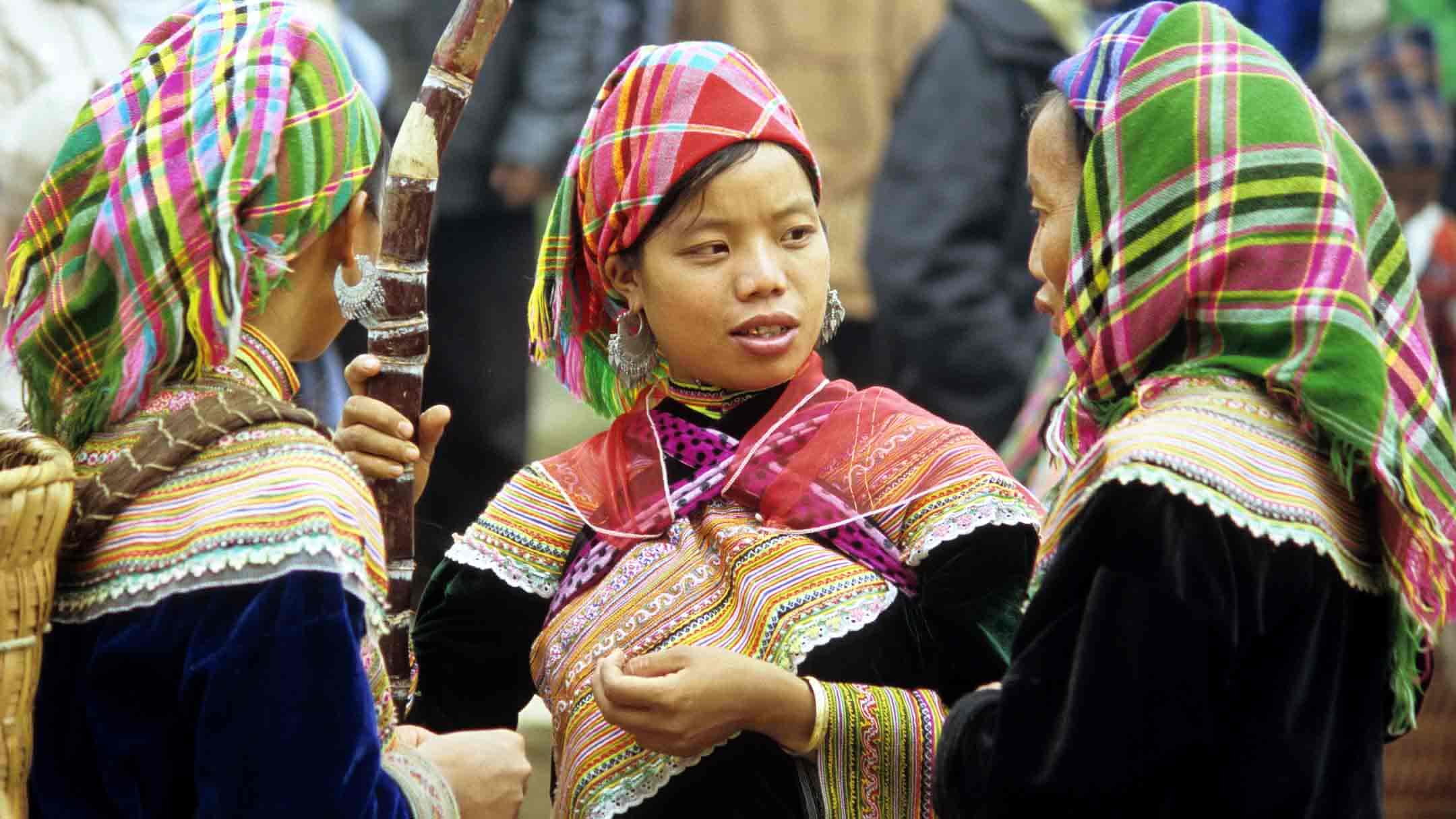
Experience some of Vietnam’s rich ethnic diversity at the busy hill tribe markets in Sapa, Bac Ha, and Can Cau – rewarding for photographers, and definitely worth the effort to get there
By Rick’s Café Noir – 1 October 2025
Most visitors planning to visit the hill tribe markets in Bac Ha and Can Cau will base themselves in Sapa, a busy town in Lao Cai province in the mountainous northwest of Vietnam. Depending on how much time you have, this may or may not be the best option. The problem is that the best days to visit these markets are at the weekend, and the busiest time is usually in the mornings.
Click on the links below to jump to:
- Getting There
- Sapa Market
- Bac Ha Market
- Can Cau Market
- Flower Hmong
- Flower Hmong Babies
- Flower Hmong Clothing
- Hill Tribe Fabrics
- Last Thoughts
- Camera Gear
Getting There
The bus drive from Sapa to Bac Ha takes about three hours in winter, on steep winding roads from Sapa down to Lao Cai, and then more steep winding roads from Lao Cai up to Bac Ha. Driving from Bac Ha up to Can Cau is another half an hour on more steep winding roads – and in winter, you could be driving up into the clouds. So, choices have to be made if time is limited, and hopefully, this post will help you decide.

©2025 Rick Piper Photography. View a hi-res version of this image at rpphotoz.com
Sapa is more than just a market town. Besides having its own large market, the surrounding area has extensive rice terraces, trekking trails, and nearby Mount Fansipan (3143m) – attracting a lot of tourists interested in a lot more than the weekend market. It is worth noting that if you visit in the winter you may not see any of this – Sapa could be in the clouds!
Sapa is usually reached by train or bus from Hanoi to the town of Lao Cai, near the Chinese border, and then a bus or taxi up to Sapa. The relative ease of making this trip shows in the huge numbers of tourists in the town.
Visiting Bac Ha and Can Cau takes a bit more effort. Sapa market operates every day, but is busiest at the weekend, particularly on Sunday, but so are the markets at Bac Ha and Can Cau. Sunday is the main market day in Bac Ha, and Can Cau market is only on Saturday. The busiest time in all three markets is in the morning, so how best to visit them all?
Having visited all three markets I would say Bac Ha and Can Cau are the more rustic and colourful – both being in scenic locations and attracting diverse ethnic groups, but with far fewer tourists. My advice would be to prioritise the Bac Ha and Can Cau markets.
You could travel directly to Bac Ha first, from Hanoi, as I did, and stay in Bac Ha for a few days, going to the Can Cau market on Saturday morning and the Bac Ha Market on Sunday morning. The Can Cau market in particular is only a once-a-week event, and both Bac Ha and Can Cau markets are more colourful than Sapa market. Then return to Sapa on Sunday afternoon and visit Sapa market during the week.
Sapa Market
Sapa is not much of a destination to visit in itself, and in winter is quite grim, but it is a good base to explore from – a lot of trekking in the surrounding valleys and mountains. I was there in December, so it was very cold, and most days clouds covered the town – you could not even see the end of the street. You could also not see the surrounding mountains, or the rice terraces. Fortunately, one day the cloud cleared and I was able to get the rice terrace image above. When the cloud does lift and the sun shines, the landscapes around Sapa are stunning. If you visit Sapa outside of winter, there is a lot more to do, especially trekking in the valleys, or up Mount Fansipan.

©2025 Rick Piper Photography. View a hi-res version of this image at rpphotoz.com
Originally, Sapa market was in the town centre, but has now been moved to a modern building near the bus station. This market is open every day, although during the week it is not as busy as the at the weekend. As with other markets in the mountains, people travel several kilometres from surrounding rural communities to the Sapa market, particularly at the weekend, to trade and socialise. There are many Red Dao (or Dzao) and Black Hmong people in traditional dress. Unmarried Red Dzao women have plain red headdresses, whereas married women have headdresses adorned with many tassels, beads, and silver coins.
Red Dzao women wear colourful trousers featuring yellow and orange designs on black fabric, and elaborately embroidered panels and sashes.

©2025 Rick Piper Photography. View a hi-res version of this image at rpphotoz.com

©2025 Rick Piper Photography. View a hi-res version of this image at rpphotoz.com
There are many Black Hmong in Sapa, noticeable by their “black” costumes. The black is actually very dark blue, from the indigo dye used on their tunics and leggings. Brightly coloured woven fabrics for the skirt complete the costume, with detailed embroidery panels on the tunic collars, sleeves and edges.

©2025 Rick Piper Photography. View a hi-res version of this image at rpphotoz.com

©2025 Rick Piper Photography. View a hi-res version of this image at rpphotoz.com
Bac Ha Market
Most tourists seem to head straight for Sapa – I did not. I took the Wednesday night sleeper train from Hanoi and arrived in Lao Cai early Thursday morning, and then took the local bus up to Bac Ha. The small town of Bac Ha is quiet during the week – and during the winter months is cold and cloudy, like Sapa.

©2025 Rick Piper Photography. View a hi-res version of this image at rpphotoz.com
In Bac Ha, by Friday, many ethnic people, mainly Flower Hmong, from surrounding villages and farming communities start to arrive. The Sunday market in Bac Ha is big, and takes place not only in the marketplace, but has stalls set up in many of the streets – the whole town becomes one big market. During the week there are a few stalls set up in the marketplace, but the main action is on the weekend.

©2025 Rick Piper Photography. View a hi-res version of this image at rpphotoz.com
Can Cau Market
In contrast, the Saturday market outside Can Cau is a lot smaller, more rustic, seems more authentic, and has fewer tourists than Bac Ha. I arrived at the Can Cau market by car at 8.30am, just as the market was getting busy. There were no other tourists in sight until mid-morning when day-trip buses from Sapa arrived (a 3.5 hour journey!). If you organise a car to take you to Can Cau, I would advise you to leave Bac Ha at 8am latest for the 20 kms drive, which is steep and winding. Even earlier would be better.
Can Cau market is located on a steep hillside, with stalls precariously supported by bamboo poles over the sloping ground, with, in winter, lots of mud and steep, muddy steps between the various levels.

©2025 Rick Piper Photography. View a hi-res version of this image at rpphotoz.com
With predominantly Flower Hmong people trading and socialising, Can Cau market is very colourful. Most of the women and girls wear their best clothes for market day, complete with gumboots or plastic sandals to deal with the mud in winter.

©2025 Rick Piper Photography. View a hi-res version of this image at rpphotoz.com
Flower Hmong
Besides buying and selling, these markets are an opportunity to socialise with family and friends, eat and drink, admire babies, and even find a future partner.

©2025 Rick Piper Photography. View a hi-res version of this image at rpphotoz.com

©2025 Rick Piper Photography. View a hi-res version of this image at rpphotoz.com

©2025 Rick Piper Photography. View a hi-res version of this image at rpphotoz.com

©2025 Rick Piper Photography. View a hi-res version of this image at rpphotoz.com
Flower Hmong Babies
Many of the women carry their babies on their backs in traditional fabric baby carriers. Sometimes, the babies are newborns, and all you can see is the top of a woolly hat in the carrier, like the image below left. Babies are keenly checked-out by family and friends, especially the new ones.

©2025 Rick Piper Photography. View a hi-res version of this image at rpphotoz.com

©2025 Rick Piper Photography. View a hi-res version of this image at rpphotoz.com

©2025 Rick Piper Photography. View a hi-res version of this image at rpphotoz.com

©2025 Rick Piper Photography. View a hi-res version of this image at rpphotoz.com
As it was winter when I visited, and very cold in the mountains, all the babies were wearing brightly coloured knitted woolly hats, often with ears.

©2025 Rick Piper Photography. View a hi-res version of this image at rpphotoz.com

©2025 Rick Piper Photography. View a hi-res version of this image at rpphotoz.com

©2025 Rick Piper Photography. View a hi-res version of this image at rpphotoz.com

©2025 Rick Piper Photography. View a hi-res version of this image at rpphotoz.com
Flower Hmong Clothing
The women – young and old – usually wear their best clothes for market day, and silver jewellery, especially large earrings. These are usually genuine silver, not like the ones often sold to tourists on the streets in Sapa by Black Hmong women, which are just metal, often made of aluminium – information told to me by a Black Hmong woman who I used to stop and talk to.
Traditionally, the vibrantly coloured clothes were hand woven fabrics with intricate embroidery – a skill passed down through generations. Nowadays, mass-produced fabrics are also used, but the embroidery is still often sewn by hand. There is colour everywhere you look. When I was there the sky was bright overcast, perfect for photography – no harsh sunlight and shadows, evenly lit, with brilliant colours.

©2025 Rick Piper Photography. View a hi-res version of this image at rpphotoz.com

©2025 Rick Piper Photography. View a hi-res version of this image at rpphotoz.com

©2025 Rick Piper Photography. View a hi-res version of this image at rpphotoz.com

©2025 Rick Piper Photography. View a hi-res version of this image at rpphotoz.com
The costumes of the Flower Hmong women feature elaborate stitching, which they often sew themselves. The women often wear vibrantly coloured plaid headscarves, as well as velvet and silk sashes.
In Sapa particularly, you will see Black Hmong woman sewing embroidery and cross-stitch when they are not trying to sell souvenirs to tourists. The hand sewing is usually for themselves or their family, being too time-consuming and valuable to sell to tourists.
Hill Tribe Fabrics

©2025 Rick Piper Photography. View a hi-res version of this image at rpphotoz.com
Ethnic designs often feature on cushion covers – particularly Black Thai designs and Hmong embroidery – which are sold to tourists by Black Hmong women in Sapa, and by souvenir shops in Hanoi. In fact, everywhere you go in Sapa, women and girls will be trying to sell you something – headscarves, sashes, cushion covers, bracelets, fake silver earrings. In the past, clothes and fabrics would have been made by the women wearing them, but now, some are factory made. This is particularly true of tourist souvenirs in Sapa and Hanoi. Some genuine articles do exist, usually for a much higher price.

©2025 Rick Piper Photography. View a hi-res version of this image at rpphotoz.com

©2025 Rick Piper Photography. View a hi-res version of this image at rpphotoz.com

©2025 Rick Piper Photography. View a hi-res version of this image at rpphotoz.com
Last Thoughts
If you have no interest in trekking or mountain climbing, and especially if it is winter and you only have the time for a few days in the northwest of Vietnam, maybe give Sapa a miss – spend the weekend in Bac Ha and Can Cau visiting their colourful markets. Try to arrive at the markets as early as possible, when there will be fewer tourists, and hope for a bright overcast day for good photography. I wish you good shooting!
Camera Gear
All images in this post were taken using Fuji Sensia transparency film in Olympus OM1 cameras, with Zuiko lenses. Transparencies were then scanned using a Nikon ED5000 film scanner and processed in Photoshop.
All images Copyright ©2025 Rick Piper Photography (unless noted otherwise). All rights reserved.

Leave a Reply