Photographing cats in the blue town in Morocco’s Rif mountains – a photo essay, and cautionary tale!
By Rick’s Café Noir – 1 October 2025
Have you heard of Chefchaouen, the blue-painted town in the Rif mountains in the north of Morocco? No? Well, the next few images will give you an idea of why it is a popular destination for visitors to Morocco. It is definitely a bucket-list destination, and although a bit out of the way it is worth the effort to go there – not being on a rail route, you will need to travel there by bus or car.
Click on the links below to jump to:
- Chefchaouen – the Blue Town
- The Stray Cats of Chefchaouen
- Rabies Risk!
- The Stray Cats of Istanbul
- The Cat Poo Problem
- Last Thoughts
- Camera Gear
Chefchaouen – the Blue Town
I will be writing a more detailed post on Chefchaouen later, but for now, this will give you a taste.

©2025 Rick Piper Photography. View a hi-res version of this image at rpphotoz.com

©2025 Rick Piper Photography. View a hi-res version of this image at rpphotoz.com
Almost all surfaces – walls, doors, paths, steps – are painted blue, especially indigo and cobalt blue. This is the main reason most tourists visit Chefchaouen. The Chefchaouen medina is similar to other medinas in Morocco, such as Tangier and Tetouan – steep, narrow streets, lots of steps, ornate doorways – except for the preponderance of blue paint. Other medinas use more colours, but Chefchaouen has capitalised on the photogenic appeal of blue paint, everywhere. It is very photogenic – so much so, there are now thousands of images of Chefchaouen on the internet. Maybe millions!

©2025 Rick Piper Photography. View a hi-res version of this image at rpphotoz.com

©2025 Rick Piper Photography. View a hi-res version of this image at rpphotoz.com
Chefchaouen was founded in 1471 by Riffian Berber tribes. It expanded from 1494 with the arrival of Muslim and Jewish refugees from Granada, Spain, who built the typical Hispanic-style whitewashed houses with small balconies, tiled roofs, and enclosed courtyards.
Have the buildings always been painted blue?
No, in the 1930s, a new influx of Jewish refugees introduced the blue washes to the buildings. Before that, the buildings were mostly painted white, with green doors and windows – a traditional Muslim colour.
If you are a collector of door photos, and especially blue doors, Chefchaouen – and Morocco generally – is a great place to visit.


The Stray Cats of Chefchaouen
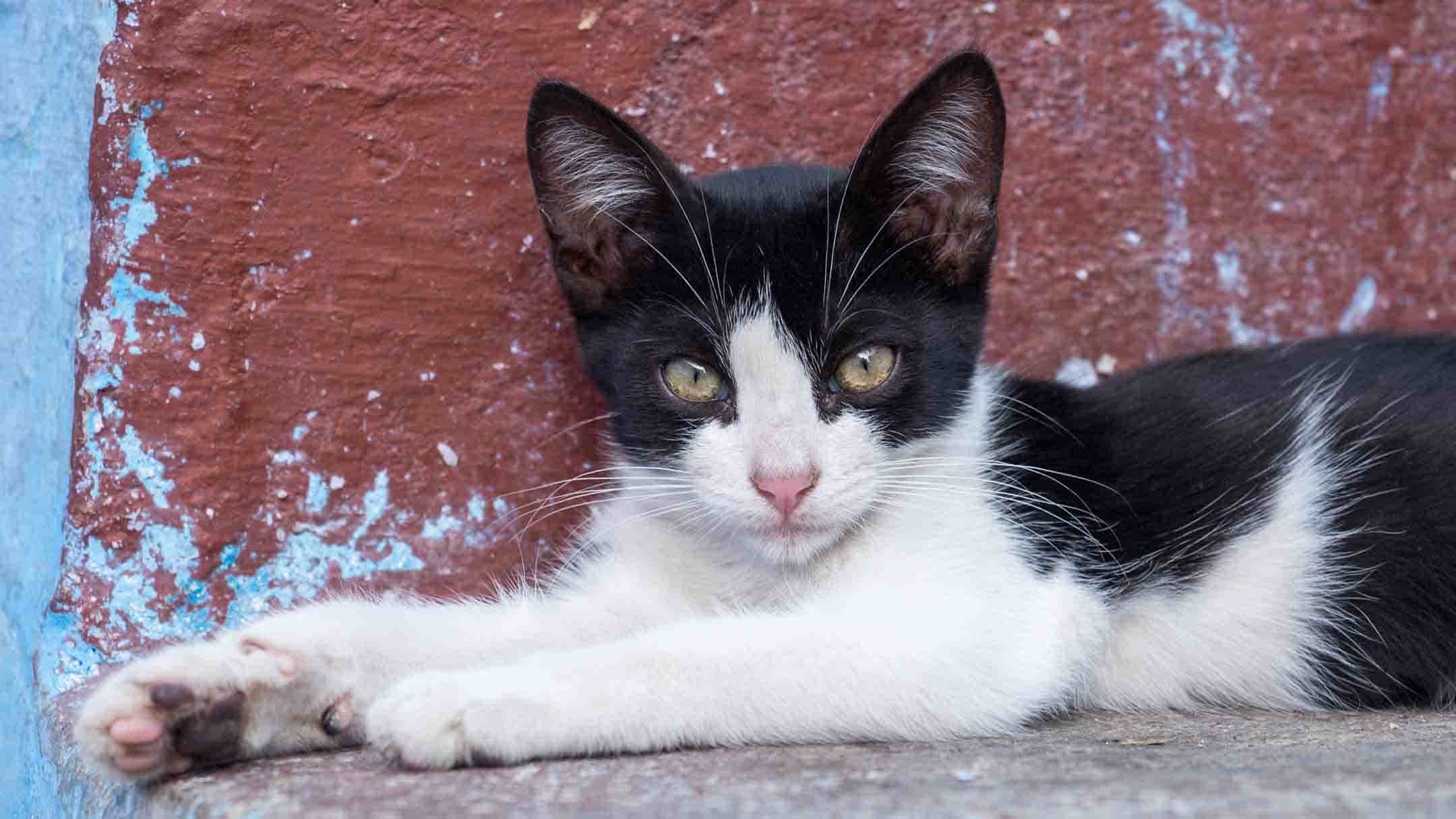
Cat lovers also go to Chefchaouen, to photograph the stray cats.

Stray black and white cat in a Chefchaouen street, Morocco.
©2025 Rick Piper Photography. View a hi-res version of this image at rpphotoz.com
There are stray cats almost everywhere you look in Chefchaouen, relaxing in the streets and doorways by day, and active at night hunting for food.

©2025 Rick Piper Photography. View a hi-res version of this image at rpphotoz.com
They are generally tolerated by the locals as they are good ratters and mousers, helping to keep down the vermin population in the medina, but they are not really treated like pets. They do, however, make good subjects for photography, especially with blue walls as backgrounds.

©2025 Rick Piper Photography. View a hi-res version of this image at rpphotoz.com
Rabies Risk!

©2025 Rick Piper Photography. View a hi-res version of this image at rpphotoz.com
Unfortunately, some of the cats are in a dire state – thin, mangy, diseased, and with eye infections. I know it is very tempting, but if you like stroking cats, I would be very wary in Chefchaouen. Rabies is endemic in Africa, including Morocco, and most government travel advisories advise against contact with feral animals. Rabies in Morocco is mostly carried by dogs, but cats can also be carriers, so avoid being scratched or bitten. Do not end up like this unfortunate tourist, who died in June 2025 after contracting rabies as the result of a scratch from a stray puppy whilst on holiday in Morocco four months previously.
Rabies is serious. As the Travelvax Australia website says: “Rabies is almost always fatal and treatment is supportive – there is no cure” [my emphasis]. The website also states:
While the most common way for humans to become infected with the rabies virus is through a bite, it can also occur through non-bite direct contact with the saliva or brain/nervous system tissue of an infected animal: this may be via a scratch if the animal had licked its claws, or from a lick to an open wound, or through contact with the mucous membranes of the mouth, nose or eyes. (Travelvax Australia website, 2023)
This is what happened to the above-mentioned tourist. So, to repeat – rabies is serious. Do not end up as a rabies fatality – do not touch the cats, just take photos.
Most of the cats I photographed looked healthy – that is why I chose them as subjects, although I did keep my distance, and shot with a long lens – but there were many other cats that did not look healthy.

©2025 Rick Piper Photography. View a hi-res version of this image at rpphotoz.com

©2025 Rick Piper Photography. View a hi-res version of this image at rpphotoz.com

©2025 Rick Piper Photography. View a hi-res version of this image at rpphotoz.com
The cats are easy to photograph, not being too perturbed by humans. They mostly ignore us – unless you invade their space, or threaten them in any way.

©2025 Rick Piper Photography. View a hi-res version of this image at rpphotoz.com

©2025 Rick Piper Photography. View a hi-res version of this image at rpphotoz.com
Taking photos can seem threatening to a feral cat if you try to get too close, and some of them can be aggressive. I obviously got a bit too close to the black cat below, who first gave me an angry look, and then an aggressive snarl! So, best to keep your distance and use a long lens.

©2025 Rick Piper Photography. View a hi-res version of this image at rpphotoz.com

©2025 Rick Piper Photography. View a hi-res version of this image at rpphotoz.com
In one of the main streets of souvenir shops I met a foreigner who lived in Chefchaouen, who was busy putting antibiotic eye drops – bought from a local vet – into the eyes of any cats he could grab, especially the kittens. Altruistic, I know, but highly risky, considering the risk of contracting rabies from a scratch or bite!

©2025 Rick Piper Photography. View a hi-res version of this image at rpphotoz.com

©2025 Rick Piper Photography. View a hi-res version of this image at rpphotoz.com
He pointed dismissively to a pile of food put out for the cats. He was complaining, because the food was basically kitchen scraps, including egg shells and orange peel. Not only was most of it inedible, but it looked unsightly in a main street of souvenir shops.
The Stray Cats of Istanbul
In Istanbul there are also many stray cats – so well known you can buy postcards of them – but they look healthier. I have seen home-made cat houses, or cat boxes, built against walls to provide shelter, particularly from the rain and snow in winter. Also, feeding stations with bowls for fresh water and dry, crunchy cat food. The image below shows cat houses – basic shelters – in Istiklal Caddesi, one of the main shopping streets in Istanbul.

©2025 Rick Piper Photography. View a hi-res version of this image at rpphotoz.com
These cat houses were in the doorway of Botter House, a beautiful example of Art Nouveau architecture that was abandoned and decaying until a few years ago – once was splendid!
It is now splendid once again, having recently been returned to its former glory thanks to restoration by the heritage department of the Istanbul Metropolitan Municipality, and now functions as an art and design centre.
No cat houses in the doorway now, though! The cats have been evicted, but are hopefully not homeless.
Below is an image of cat houses in front of an abandoned and much graffitied building in the backstreets of Beyoglu, Istanbul. Just basic boxes, but they do provide shelter from the winter weather.

©2025 Rick Piper Photography. View a hi-res version of this image at rpphotoz.com
The Cat Poo Problem
Once you’ve been wandering around Chefchaouen for a while you will probably notice there is almost no open ground for planting, no garden beds, no grass, no greenery other than a few pot plants – every street, alley, lane, courtyard, and set of steps are either made of stone or concrete, and often painted blue.

©2025 Rick Piper Photography. View a hi-res version of this image at rpphotoz.com
I’m sure there are landscaped gardens in private courtyards, but all the public areas are mostly hard landscaping, with a few potted plants and flowers.

©2025 Rick Piper Photography. View a hi-res version of this image at rpphotoz.com

©2025 Rick Piper Photography. View a hi-res version of this image at rpphotoz.com
This creates a bit of a dilemma for all the cats – where to poop? Usually, cats scrape a hole in the dirt, and then cover up the droppings, but in Chefchaouen there is almost no dirt. Consequently, the cats drop poo on the paths and steps, and in doorways. You really need to look where you are walking!
Before I went to Chefchaouen I did lot of research, but no one mentioned the cat poo. Post-trip, I have since searched again and found a one-liner near the bottom of a blog post that warns readers about it, but nothing else. On a short trip of only one or two nights in the town, it is probably not so much of a problem, but I was there for two weeks taking photos, so, increasing my exposure!
One day I noticed I was picking up leaves and litter on the underside of my right boot. A quick check revealed cat poo in the tread of my Merrells. I then spent most of the next hour poking it out, and going back to my guesthouse to give my boot sole a thorough clean in hot water in the shower.
Last Thoughts
So, although I know the pursuit of photography can be all-engrossing at times, it pays to be vigilant. When in Chefchaouen, beware the cat poo – and the rabies risk!
I spent two weeks in Chefchaouen taking photos and I only saw one dog, obviously a pet, not a stray, but it was only later, after I had departed Morocco, that I realised – I had not seen or heard any birds in the blue town, not one! Maybe I was too engrossed in photographing blue streets and cats to notice any birds – I am sure they must be there. If you spotted any birds in Chefchaouen, let me know in the comments.
Do you have any Moroccan cat experiences to share? What did you think of Chefchaouen? Let me know in the comments below.
Camera Gear
All images in this post were shot in RAW using digital micro four thirds Olympus OMD camera bodies, with Zuiko PRO f2.8 lenses, and then processed in Lightroom and Photoshop.
All images Copyright ©2025 Rick Piper Photography (unless noted otherwise). All rights reserved.
