If you wake up to a blue sky day in Phnom Penh consider visiting these three landmark locations
By Rick’s Café Noir – 1 October 2025
Should your travels take you to Phnom Penh, the capital of Cambodia, and you wake up to a blue sky day – carpe diem! (seize the day!). A clear blue sky will help you capture some stunning images, because, as the old adage says, everything looks better with a blue sky. From editorial travel articles to promotional advertising, blue skies predominate. So, if you want to sell your travel images, or have an eye-catching print on your wall, make the most of blue sky days.
Instead of going shopping or checking email/blogging in a cafe, consider visiting three landmark destinations in the city.
Click on the links below to jump to:
- Psar Thmei – the Central Market
- The National Museum of Cambodia
- The Royal Palace of Cambodia
- The Reamker
- Royal Palace Visiting Hours and Fees
- Royal Palace Park
- Last Thoughts
- Camera Gear
Fortunately, the three destinations are not very far apart, so you can easily walk between them, and, as most of the streets have a number, no name, it is very easy to find your way around.
The distance from the market to the museum and palace complex is only about 1.5 kms (1 mile), but if you are not up to that walk in 38C temperatures (over 100F) then take a tuk-tuk, rickshaw, or taxi using the Cambodian ride-hailing app, PassApp.
Download the app onto your phone, activate it, and then it is easy to request a ride. Enter your destination and preferred style of transport in the app – which already knows where you are – and a nearby driver will accept the job. The app will tell you when the driver will get to you – you can see their location on the street map – and most importantly, the app tells you what the fare will be. No more arguing with tuk-tuk drivers over the fare; no more taxi drivers refusing to use the meter (broken!) or taking the long way. The agreed fare is on the app screen.
If, when I reach my destination, the driver asks for more than the agreed fare, I refuse to pay more, and just pay them the agreed amount – and then report them to PassApp. On the other hand, if the driver is friendly and takes me to my destination without expecting more than the agreed fare, I always tip them extra. This app takes all the hassles out of using tuk-tuks and taxis.
Psar Thmei – the Central Market
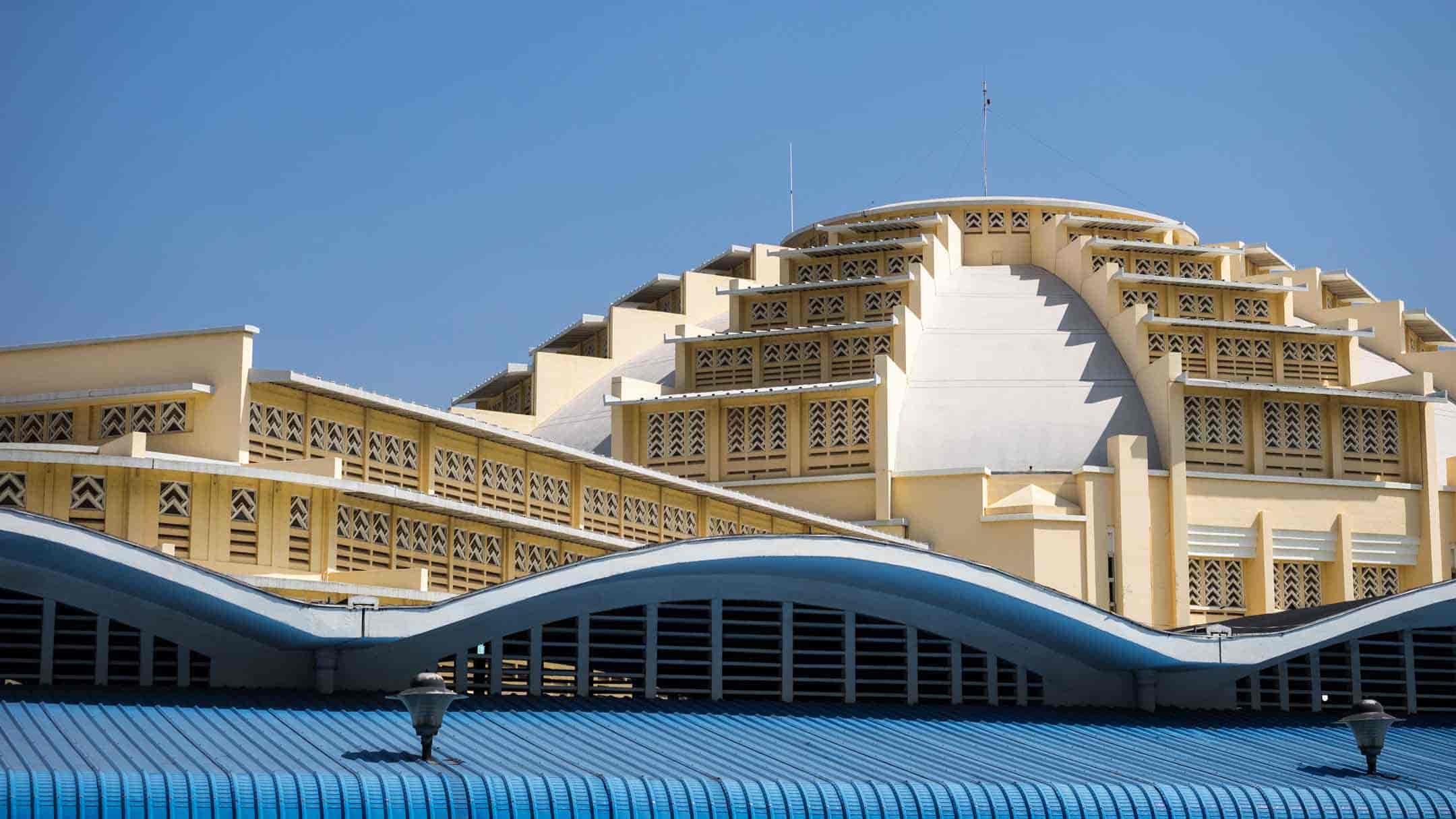
The first destination is Psar Thmei, the Central Market building, a vast complex of market stalls at the end of St 130, less than a kilometre from the riverfront. The roof-line of this Art Deco building, completed in 1937 and designed by French architect Jean Desbois, features in the image below – the pale yellow roof of the building sandwiched between a blue sky and a blue lower roof.

©2025 Rick Piper Photography. View a hi-res version of this image at rpphotoz.com
The huge open dome, 26 metres high, allows for good ventilation, so even on a very hot day the interior of the building is cool.

©2025 Rick Piper Photography. View a hi-res version of this image at rpphotoz.com
The two images above were taken at different times on different days – the first at 12.50pm, and the second at 3.20pm – so regardless of what time you are there, you can usually get a good shot, because there are four sides and angles to choose from.
You can also get aerial shots of Psar Thmei market from the nearby Sorya Center Point shopping centre, a few metres south of the market in St 63 – go up to the top floor balcony by taking the lift to the 8th level.
National Museum of Cambodia
About 1.5 kms southeast of the Central Market is the National Museum of Cambodia, just north of the Royal Palace complex. To walk there from the Central Market take St 63 south until you reach St 154, turn left and walk east until you reach Norodom Blvd and then head south along the Blvd to St 178, turn left and head east, and then turn right into St 13 – the museum is up ahead.
The museum buildings, designed by French historian and architect George Groslier, blend traditional Khmer temple architecture shown in the ancient Angkor bas-reliefs, with a French colonial-era reinterpretation, and were constructed between 1917 and 1924 .

©2025 Rick Piper Photography. View a hi-res version of this image at rpphotoz.com
The buildings are painted in a combination of reddish-brown terracotta and lighter brown colours, with unglazed clay roof tiles on steeply pitched, multi-tiered roofs with temple-like pointed finials, and carved gable ends.

©2025 Rick Piper Photography. View a hi-res version of this image at rpphotoz.com
Four display pavilions surround an inner courtyard, which features lotus ponds, paths, a central pavilion with a Leper King statue, and greenery – combined with a blue sky, these colours can look quite dramatic.

©2025 Rick Piper Photography. View a hi-res version of this image at rpphotoz.com

©2025 Rick Piper Photography. View a hi-res version of this image at rpphotoz.com
The steeply sloping, multi-tiered tiled roofs, curved and pointed, hornlike finials, and carved gable ends make for some interesting compositions, especially with a blue sky as a backdrop. As these features occur on all sides and corners of the building, it is possible to get good lighting at most times of the day.
My visits have usually been in the early afternoon, but you could visit at most times and get dramatic photos because the courtyard will look good from one side or the other, regardless of the sun’s position – maybe avoid early morning or late afternoon if you want to avoid long shadows. If you are after particular lighting for a feature, maybe check out the Photographer’s Ephemeris, which will give the sun’s location for any time and date.

©2025 Rick Piper Photography. View a hi-res version of this image at rpphotoz.com
Centred in the courtyard is a roofed pavilion housing a stone statue of the “Leper King” – not a Buddha statue, and possibly not a leper or king, either! This statue is a copy of the original statue from the Leper King Terrace in Angkor Thom. The original statue was stolen from Angkor Thom, then recovered, and is now displayed inside the National Museum. The statues in the museum courtyard and in Angkor Thom are both copies. To get a photo without the cafe umbrellas in the background, shoot from the cafe side of the courtyard. The Photographer’s Ephemeris can help you work out the best time for that shot.
The museum has the largest collection of Khmer artifacts in the world, over 14,000 items, which cover Cambodian history from pre-historic times, through the Angkor period, and into the decline of the empire after that golden age. The museum has had some success repatriating some of the thousands of artifacts looted since discovery of the Angkor temples by Europeans, which are often displayed after acquisition.
After taking photos in the courtyard, which does not take long, it is well worth spending a hour or so viewing the exhibits. One particularly interesting exhibit is a carved sandstone pediment from the Banteay Srei temple.

©2025 Rick Piper Photography. View a hi-res version of this image at rpphotoz.com
If you have ever wondered how the stonemasons managed to carve foliage so that it looks like stone has been removed from behind the leaves, a very delicate operation with sandstone, examine this pediment closely. As you are not allowed to take photos in the galleries I cannot show you the actual pediment, so the image to the left is an example from the actual Banteay Srei temple. The technique is simple, and often used in deeper bas-relief stone carving – the stone behind the foliage is tapered inwards slightly, which gives the effect of the foliage floating above the stone background.

©2025 Rick Piper Photography. View a hi-res version of this image at rpphotoz.com
Around the exterior of the building are some interesting timber doors – carved with Buddhist iconography and painted black.
The museum is open from 8am to 5pm every day. Entry fees for foreigners are $10 for adults (18+ years), $5 for 10 to 17 years, free for young children.
Photography is allowed in the inner courtyard and around the exterior, but no photography is allowed within the museum galleries. There is a cafe inside the building, looking out onto the courtyard, and toilets downstairs.
Royal Palace of Cambodia
Next to the National Museum is the Royal Palace of Cambodia, a complex of buildings that serve as the official residence of the King of Cambodia – the western courtyard is private, containing the King’s private residential villa, so not accessible by tourists. The first palace on this site was constructed by King Norodom between 1866 and 1870, and closely resembled the Grand Palace in Bangkok at that time.
With steeply pitched roofs, glazed roof tiles, and pointed temple-like finials, the many buildings in the landscaped grounds of the Royal Palace are impressive when photographed against a blue sky. Whereas the National Museum is predominantly a reddish-brown terracotta colour, the Royal Palace buildings are predominantly white, gold, green and red.

©2025 Rick Piper Photography. View a hi-res version of this image at rpphotoz.com
The Chan Chhaya Pavilion, known as the Moonlight Pavilion, next to the enclosing wall on the eastern side of the complex, at the northern end, is particularly impressive. Surrounded by extensive landscaped gardens, and usually with fewer tourists than the Silver Pagoda and Throne Hall, some creative compositions are possible.

©2025 Rick Piper Photography. View a hi-res version of this image at rpphotoz.com

©2025 Rick Piper Photography. View a hi-res version of this image at rpphotoz.com

©2025 Rick Piper Photography. View a hi-res version of this image at rpphotoz.com
The Banquet Hall, also known as the Phochani Pavilion, was built in 1912 and is used for banquets on the King’s birthday. This open-sided pavilion is also not usually as busy with tourists as the Silver Pagoda and Throne Hall, and is surrounded by landscaped gardens.
The gable ends of the Banquet Hall are richly carved and gilded, with a red background.
The roof tiles on this building are predominantly red, with green borders, with the red tiles continuing up the spire, which has a gilded finial and highlights.

©2025 Rick Piper Photography. View a hi-res version of this image at rpphotoz.com

©2025 Rick Piper Photography. View a hi-res version of this image at rpphotoz.com

©2025 Rick Piper Photography. View a hi-res version of this image at rpphotoz.com
In various locations around the complex you will find some carved, richly-gilded timber doors with red backgrounds. They often have bas-relief-style carvings of foliage, similar to that at temples such as Banteay Srei, in the Angkor Archaeological Park – the seemingly undercut foliage shown in the two images to the left being considerably easier to achieve in wood than in sandstone. Buddhist iconography is also a common theme, as in the image below.

©2025 Rick Piper Photography. View a hi-res version of this image at rpphotoz.com

©2025 Rick Piper Photography. View a hi-res version of this image at rpphotoz.com
The enclosing walls of the Silver Pagoda compound feature ornate gatehouses, such as the image below left. These gatehouses continue the temple design theme on a smaller scale, but still include carved gilded gables, temple-inspired finials, tiled roofs, and gilded spires.
There are also ornate metal door screens – part of one is shown below right. When I was there, the screens were faced with a clear acrylic sheet, which reflected a lot of glare, requiring some dodging and burning in Photoshop to produce a clear image.

©2025 Rick Piper Photography. View a hi-res version of this image at rpphotoz.com

©2025 Rick Piper Photography. View a hi-res version of this image at rpphotoz.com
The Reamker (Cambodian Ramayana)
On the cloister walls of the courtyard surrounding the Silver Pagoda is a painted mural of the Ramayana, known as the Reamker in Khmer – the Cambodian version of the epic Sanskrit poem. Over 600 metres long (about 1970 feet), and up to 3.5 metres high (about 11.5 feet), the mural covers about 2000 square metres of wall (about 22,500 square feet). It was painted in the early 1900s, but has been eroded by the weather and micro-organisms, so parts of it are in a poor state.
The story starts at the right side of the gate in the centre of the eastern cloister wall, and finishes at the left side of the same gate. The narrative is continuously painted as a single panel from beginning to end, with the main scenes separated by vegetation, boulders, or occasionally a river.
I intend to post a photo essay on the Reamker, but for now, this is a taster of what to expect when you visit the mural at the Royal Palace – which was actually the highlight of the visit for me.

©2025 Rick Piper Photography. View a hi-res version of this image at rpphotoz.com

©2025 Rick Piper Photography. View a hi-res version of this image at rpphotoz.com
Royal Palace – Visiting Hours and Fees
The entry fee for foreigners is $10, and you get three hours to view everything – which will probably include queuing to view the interiors of the Silver Pagoda and Throne Hall – and take photos in the landscaped grounds. On a busy day it may not be enough time.
It seems expensive when you consider that for same amount (on a 7-day visitor’s pass) you can enter the Angkor Archaeological Park, starting at 5am and finishing at 7pm, and view as many temples as you wish within the Park. Maybe what is needed is Cultural Pass for one fee that allows visits to various cultural and historic sites within a designated period – similar to the pass available in Hoi An, Vietnam.
The opening hours are 8am to 11am, and 2pm to 5pm daily, but note that the complex is closed on most Cambodian public and religious holidays, and may be closed during official royal functions.
Closing the Royal Palace complex between 11am and 2 pm could be considered fortunate, really – it means you avoid taking photos in the harsh light around midday, although it would be a good time to view the interiors of the Silver Pagoda and Throne Hall.
All of these images of the Royal Palace were taken on the same afternoon, between 3pm and 4.30pm. At that time of day the shadows are beginning to get longer, so arriving earlier would be better.
It is worth noting that by mid-afternoon there will be long queues of visitors waiting to go into the Silver Pagoda and Throne Hall – very popular with local Cambodians, especially at weekends – so if seeing the interiors of these buildings is important to you, it may be better to visit in the morning.
If you decide to visit in the morning my advice would be to enter at 8am and go straight to The Silver Pagoda and/or the Throne Hall to view the interiors – mainly because the sun is lower at this time and the shadows will be longer. After viewing inside, the sun will be higher, with shorter shadows cast – better for photography.
If you decide to visit in the afternoon my advice would be to enter at 2pm and start taking photos, while the sun is higher and the shadows are shorter. Then, later in the afternoon, as the sun is going down, queue to visit the interiors of the Silver Pagoda and/or the Throne Hall – there may not time for both if you leave it too late, so check the queues as you are shooting.
Photography is permitted throughout the grounds, but not inside the Silver Pagoda or the Throne Hall – check the signage on the outside of buildings. The 3-hour slots give you plenty of time to explore and take photos, in theory, but be aware that with the restricted opening hours it can get very busy, especially if you want to view the interiors of the Silver Pagoda and Throne Hall.
Royal Palace Park
Outside the Royal Palace complex is the Royal Palace Park, between the eastern enclosure wall of the Royal Palace and the Sisowath Quay road. A serene, grassy park – an oasis amid the traffic noise of Phnom Penh, and a relaxing way to end a busy blue-sky day.
It is very popular with locals for picnics, especially in the evenings when temperatures drop a little, and is a short stroll to the riverfront, which usually has cooling breezes after sunset. There are a variety of food and drinks carts at all times, more so in the evenings – including cooked bugs! I have never been game to try them, but if you have, I would be interested to know what you thought of them. Let me know in the comments below.
Last Thoughts
Although the emphasis of this blog post has been on making the most of blue sky days, sometimes, buildings with an overcast sky can be dramatic. The image below, taken in Istanbul, was the result of a very small patch of blue sky, in an otherwise totally overcast sky, allowing the sun’s rays to shine on the domes of Rustem Pasa Mosque (at front) and Suleymaniye Mosque – it was all over in about two seconds, so be ready to press that shutter button!

©2025 Rick Piper Photography. View a hi-res version of this image at rpphotoz.com
Camera Gear
All images in this post were shot in RAW using digital micro four thirds Olympus OMD camera bodies, with Zuiko PRO f2.8 lenses, and then processed in Lightroom and Photoshop.
All images Copyright ©2025 Rick Piper Photography (unless noted otherwise). All rights reserved.
